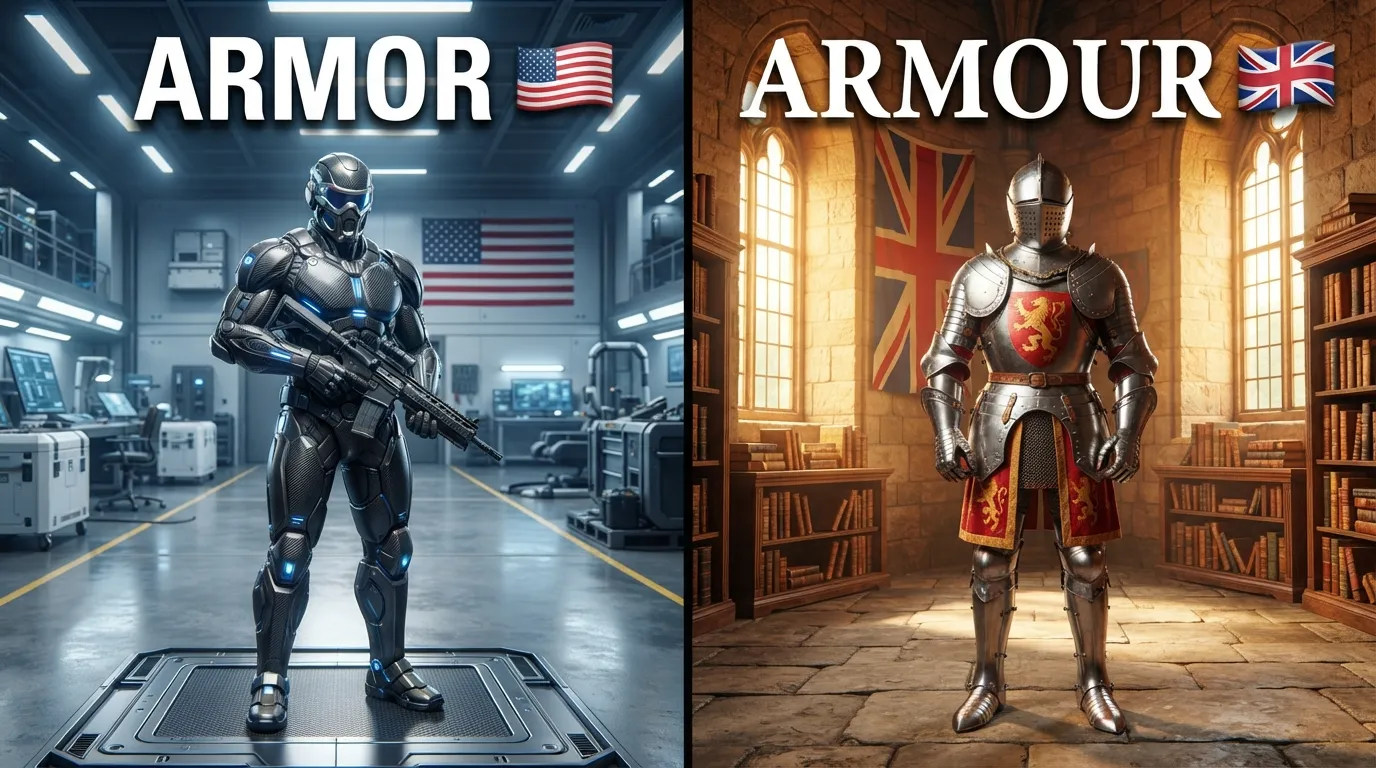
Both spellings are correct. Armor is the standard spelling in American English, while armour is the standard spelling in British English, Canadian English, and most other English speaking countries outside the United States.
I once edited a fantasy short story for a writer who used both spellings in the same paragraph, sometimes armor, sometimes armour, without noticing the switch. She was convinced one of them had to be wrong.
Neither was wrong. She had simply grown up reading British fantasy novels while writing for an American audience, and the two spellings blended together in her head.
This happens constantly with words that split along regional lines. Readers assume there must be one single correct answer, when really the answer depends on which English speaking audience you are writing for.
This guide clears up the confusion completely. You will learn exactly which spelling fits which audience, why the split exists, and how to stay consistent throughout any piece of writing.
Armour or Armor: Quick Answer
Armor is the preferred spelling across the United States, used in American publishing, business writing, and everyday communication.
Armour is the preferred spelling in the United Kingdom, Canada, Australia, and most Commonwealth countries, following traditional British spelling conventions.
Example: An American video game manual will describe “upgrading your armor,” while a British novel will describe a knight’s “gleaming armour.”
The Origin and Background of Armor and Armour
Both spellings trace back to the Old French word armure, which itself came from the Latin word armatura, meaning equipment or arms. The word entered English during the medieval period, alongside many other French influenced military and legal terms.
For centuries, English spelling was far less standardized than it is today, and words like armour appeared in multiple forms depending on the writer, region, and printer. British English eventually settled on the our ending, following the French spelling pattern that also shaped words like colour, honour, and favour.
American English took a different path in the early nineteenth century, largely due to lexicographer Noah Webster. Webster believed American English should simplify certain British spelling patterns, and he specifically promoted dropping the u in words like armour, colour, and honour to create a more streamlined American standard.
That single decision explains most of the or versus our spelling split you still see today. It was not an accident or a modern internet trend. It was a deliberate, documented effort to create a distinct American spelling identity.
Armor vs Armour Explained: Key Differences and Variations
| Term | Meaning | When to Use | Region/Context |
|---|---|---|---|
| Armor | Protective covering or equipment | American writing, business, and media | United States |
| Armour | Same meaning, traditional British spelling | British, Canadian, and Commonwealth writing | United Kingdom, Canada, Australia, and beyond |
| Armored or Armoured | Adjective form describing protected vehicles or equipment | Follows the same regional spelling pattern | Matches whichever base spelling you are using |
The meaning never changes between the two spellings. The only difference is which regional audience expects which version, similar to the split between color and colour, or favor and favour.
Which Spelling Should You Use?
American Writers and Publications
Use armor. It matches American style guides, including AP style and Chicago style, along with nearly all major American publishers and news outlets.
British, Canadian, and Australian Writers
Use armour. It matches Oxford style, most Commonwealth style guides, and reader expectations across these regions.
Video Game and Software Localization
Match the spelling to your target region. Games sold primarily in the United States typically use armor, while those localized for British or Australian markets often switch to armour.
Global or Mixed Audience Writing
Pick one spelling and stay consistent throughout the entire piece. Consistency matters more than which specific spelling you choose when your audience spans multiple regions.
Academic and Historical Writing
Follow whichever style guide your institution or publisher requires, since historical and academic writing often defers to a specific regional standard regardless of the author’s personal background.
If you remember only one rule, remember this: armor stays American, armour stays everywhere else, and neither one is ever actually wrong.
Common Mistakes with Armor and Armour
Mistake 1: Mixing Both Spellings Within the Same Document
Correction: Choose one spelling at the start of your project and use a find and replace check before publishing to catch any inconsistencies.
Mistake 2: Assuming One Spelling Is More Correct Than the Other
Correction: Neither spelling is more correct in an absolute sense. Correctness depends entirely on which regional English standard you are following.
Mistake 3: Forgetting That Related Words Follow the Same Pattern
Correction: Words like armored, armorer, and armor plated should match your base spelling choice, as should armoured, armourer, and armour plated in British English.
Mistake 4: Switching Spellings Based on Personal Reading Habits
Correction: Base your spelling choice on your actual target audience, not simply on which books or shows influenced your own vocabulary growing up.
Mistake 5: Assuming Autocorrect Will Choose the Right Regional Spelling
Correction: Many spellcheck tools default to American English unless manually changed, which can quietly convert armour to armor without you noticing during editing.
Each of these mistakes happens because writers rarely stop to define their target audience clearly before choosing a regional spelling and sticking with it.
Armor and Armour in Real World Examples
Professional Email
“Our American distribution team confirmed the packaging will use the armor spelling for all United States retail listings.”
News Headline
“Museum Unveils Rare Medieval Armour Collection Ahead of Summer Exhibition”
Social Media Post
“Finally finished painting my knight miniature. That armor took way longer than I expected.”
Formal Document
“This historical report references armour, following the British spelling conventions used throughout the original archived documents.”
Notice how the correct spelling shifts depending on audience and context, not because one version is inherently better than the other.
Armor and Armour: Data, Trends, and Usage
Searches comparing armor and armour happen consistently, driven largely by writers, gamers, and content creators working across international audiences.
American audiences overwhelmingly search and use armor, while searches for armour concentrate heavily in the United Kingdom, Canada, Australia, and other Commonwealth regions.
This search falls mostly into the informational category, though it occasionally overlaps with content creation needs, especially among game developers and authors localizing content for different markets.
Global publishing and international game development continue to keep this spelling question relevant, since more creators now write for worldwide audiences rather than a single regional market.
Standalone Comparison Table
| Term/Variant | Meaning | Region/Context | Best Used When |
|---|---|---|---|
| Armor | Protective covering or equipment | United States | Writing for an American audience |
| Armour | Same meaning, traditional spelling | United Kingdom, Canada, Australia | Writing for a Commonwealth audience |
Frequently Asked Questions
What does armor mean?
Armor means protective covering or equipment worn or used to defend against harm, whether describing medieval knights, modern vehicles, or protective gear in general.
How do you use armor correctly in a sentence?
Use armor as a noun to describe the protective material itself, such as “the knight wore heavy armor,” matching your chosen regional spelling throughout the sentence.
Armour vs armor, what is the actual difference?
There is no difference in meaning at all. Armor is the American spelling, and armour is the British and Commonwealth spelling, both describing identical protective equipment.
Is armour acceptable in American formal writing?
Generally no. American style guides and publishers expect armor, so armour may be flagged as inconsistent or incorrect in American formal writing.
Which version is correct, armor or armour?
Both are correct, depending entirely on your audience. Armor is standard in the United States, while armour is standard nearly everywhere else in the English speaking world.
Where does the word armor come from?
Armor comes from the Old French word armure, itself derived from the Latin armatura, meaning equipment or arms, entering English during the medieval period.
Can armor and armour be used interchangeably in casual writing?
Yes, in casual writing, readers generally understand both spellings without confusion, though staying consistent throughout a single piece still looks more polished and professional.
Final Thoughts
Armor and armour describe the exact same thing, protective covering built to defend against harm. The only real difference comes down to geography, not correctness.
Remember the core takeaway here. Choose armor for American audiences, armour for British and Commonwealth audiences, and stay consistent once you pick a side.
Bookmark this guide so you never second guess this spelling again, and share it with any writer who has ever caught themselves switching between the two mid paragraph.
Read More: Clutz or Klutz: The Correct Spelling Explained

I’m Zain. I got interested in commonly confused words while helping non-native English speakers prep for writing exams, where a single misused word could cost real marks. That experience shaped how I write now: I try to explain not just which spelling is correct, but why the confusion exists in the first place, since understanding the reason is what actually makes it stick.