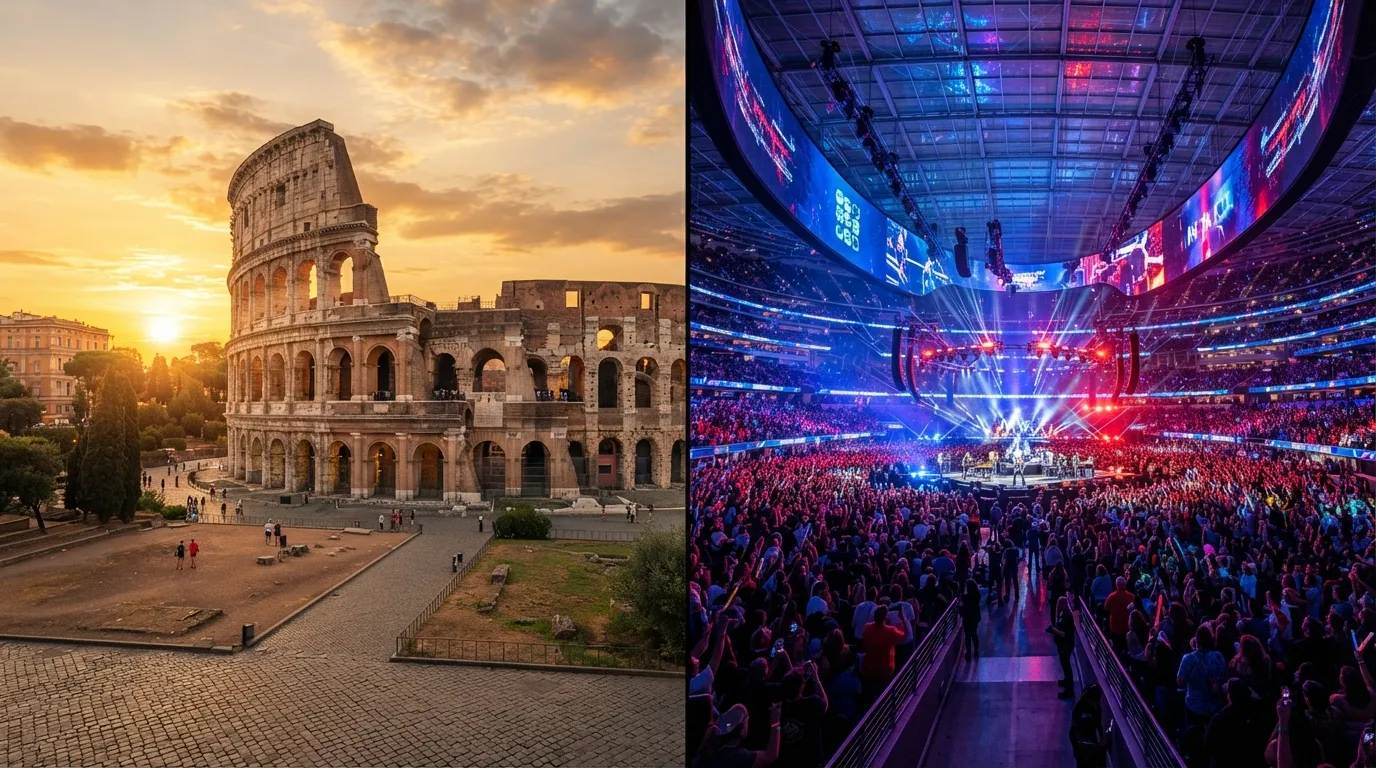
Colosseum, refers specifically to the ancient Roman amphitheater in Rome. Coliseum refers to any other large stadium or arena used for sports, concerts, or public events.
I once stood outside a sports arena in the United States, staring at a giant sign that read Coliseum, feeling genuinely confused. I had just returned from a trip to Rome, where every plaque and guidebook spelled it Colosseum.
For a moment, I assumed someone back home had simply made a spelling mistake on a massive, expensive sign. They had not. Both spellings are correct, just for two completely different things.
This mix up trips up travelers, students, and writers constantly, since the words look nearly identical and sound almost the same out loud. The real distinction has nothing to do with grammar rules and everything to do with what you are actually describing.
This guide clears up the confusion for good. You will learn exactly which spelling fits which situation, where both words come from, and how to use them with total confidence.
Coliseum or Colosseum: Quick Answer
Colosseum, always capitalized, refers to the specific ancient amphitheater built in Rome nearly two thousand years ago, also known as the Flavian Amphitheatre.
Coliseum refers to any large modern stadium, arena, or theater used for sports, concerts, or events, and it never refers to the Roman landmark itself in current usage.
Example: “We toured the Colosseum on our trip to Italy” describes the famous Roman structure. “The basketball game was held at the downtown coliseum” describes a completely different, modern venue.
The Origin and Background of Coliseum and Colosseum
Both words trace back to the Latin term colosseum, which itself likely connects to the word colossus, referring to something massive or gigantic. Historians believe the name developed because a colossal bronze statue of Emperor Nero once stood near the amphitheater’s entrance.
For centuries, English speakers used both spellings somewhat interchangeably, even when referring to the famous Roman structure itself. Older texts, especially those written before the twentieth century, frequently used Coliseum for the Roman landmark without any sense that the spelling was incorrect.
Over time, English usage gradually settled into a clearer pattern. Colosseum became firmly attached to the specific Roman monument, while Coliseum became the more common choice for describing other large venues, especially as more modern stadiums and arenas adopted the word directly into their official names.
This shift happened more strongly in American English, where the split between the two uses is now widely recognized and consistently applied. British English historically leaned toward Colosseum for generic use as well, though usage patterns have shifted closer to the American pattern in recent decades.
Coliseum vs Colosseum Explained: Key Differences and Variations
| Term | Meaning | When to Use | Region/Context |
|---|---|---|---|
| Colosseum | The specific ancient amphitheater in Rome | Referring to the historic Roman landmark | Universal, always capitalized |
| Coliseum | Any large modern stadium, arena, or theater | Referring to sports venues, concert halls, or event spaces | Common worldwide, especially in the United States |
| Flavian Amphitheatre | The original formal name of the Roman structure | Academic or historical writing | Occasionally used alongside Colosseum |
The key distinction comes down to specificity. Colosseum names one particular, historic building, while coliseum describes an entire category of modern venues.
Which Spelling Should You Use?
Travel Writers and Historians
Use Colosseum whenever referring to the Roman landmark, and always capitalize it, since it functions as a proper noun naming a specific place.
Sports Writers and Journalists
Use coliseum when describing modern stadiums, arenas, or venues, matching how most contemporary buildings actually spell their own names.
Students and Academic Writers
Use Colosseum for any assignment discussing ancient Rome, gladiators, or Roman architecture, since this matches standard academic convention.
Marketing and Venue Naming
Follow the specific building’s official spelling, since many modern venues choose coliseum in their formal names, such as the Los Angeles Memorial Coliseum.
Global or General Audiences
Default to coliseum for any modern venue and Colosseum strictly for the Roman structure, which keeps your writing accurate across nearly every context.
If you remember only one rule, remember this: Colosseum is one specific place in Rome, and coliseum is everywhere else.
Common Mistakes with Coliseum and Colosseum
Mistake 1: Using Coliseum to Describe the Roman Landmark
Correction: Always use Colosseum, capitalized, when specifically referring to the ancient structure in Rome, even though older texts sometimes used the other spelling.
Mistake 2: Using Colosseum for a Modern Sports Venue
Correction: Use coliseum instead, unless the venue’s official name specifically includes Colosseum, which is uncommon in current usage.
Mistake 3: Forgetting to Capitalize Colosseum
Correction: Since Colosseum refers to one specific building, it functions as a proper noun and should always be capitalized in formal writing.
Mistake 4: Assuming One Spelling Is Simply Incorrect
Correction: Both spellings are valid English words. The distinction lies entirely in context, not correctness, so neither version is inherently wrong.
Mistake 5: Mixing Both Spellings Within the Same Document
Correction: Stay consistent by matching each spelling to its correct context throughout your writing, using Colosseum only for Rome and coliseum for everything else.
Each of these mistakes happens because the two words look and sound so similar, making it easy to default to whichever spelling feels more familiar rather than checking the actual context.
Coliseum and Colosseum in Real World Examples
Professional Email
“Our travel itinerary includes a guided tour of the Colosseum on the second day of the Rome portion of the trip.”
News Headline
“City Council Approves Funding for New Downtown Coliseum Ahead of Basketball Season”
Social Media Post
“Finally visited the Colosseum in person. Photos genuinely do not capture how massive it feels standing inside.”
Formal Document
“This architectural report compares structural elements of the Roman Colosseum with several modern coliseum designs.”
Notice how both spellings appear naturally within the same broader topic, distinguished entirely by whether the writer means the historic Roman site or a modern venue.
Coliseum and Colosseum: Data, Trends, and Usage
Searches comparing coliseum and colosseum spike heavily around travel planning seasons, especially among tourists preparing trips to Rome and researching historical landmarks.
Sports fans and event goers also search coliseum regularly, particularly when looking up local arenas, stadium seating, or upcoming events at venues carrying that name.
This search falls almost entirely into the informational category, though it occasionally overlaps with travel planning and local event searches depending on the specific context.
Continued global interest in Roman history, combined with the steady popularity of modern coliseum named venues, keeps this spelling question consistently relevant across both travel and sports related content.
Standalone Comparison Table
| Term/Variant | Meaning | Region/Context | Best Used When |
|---|---|---|---|
| Colosseum | The specific ancient amphitheater in Rome | Universal, historical and travel writing | Referring to the actual Roman landmark |
| Coliseum | Any large modern stadium or arena | Universal, especially common in the United States | Referring to modern sports or event venues |
Frequently Asked Questions
What does Colosseum mean?
Colosseum refers specifically to the ancient amphitheater built in Rome nearly two thousand years ago, historically used for gladiatorial contests and public spectacles.
How do you use coliseum correctly in a sentence?
Use coliseum to describe a modern stadium or arena, such as “the concert took place at the city coliseum,” rather than referring to the Roman landmark.
Coliseum vs Colosseum, what is the actual difference?
Colosseum refers to one specific historic building in Rome, while coliseum refers broadly to any large modern venue used for sports or public events.
Is coliseum ever acceptable when referring to Rome?
Historically yes, since older texts often used this spelling for the Roman structure, but modern usage strongly favors Colosseum for that specific landmark.
Which version is correct, coliseum or Colosseum?
Both are correct, depending entirely on context. Colosseum names the Roman landmark specifically, while coliseum applies to virtually every other large venue.
Where does the word Colosseum come from?
Colosseum comes from Latin, likely connected to the word colossus, referencing a massive bronze statue of Emperor Nero that once stood near the amphitheater’s entrance.
Can coliseum be used as part of a building’s official name?
Yes. Many modern venues, such as the Los Angeles Memorial Coliseum, use this spelling directly in their formal names, following the common noun tradition rather than the Roman landmark spelling.
Final Thoughts
Coliseum and Colosseum are not simply two spellings of the same word. Colosseum belongs to one specific, historic building in Rome, while coliseum describes an entire category of modern stadiums and arenas.
Keep the core distinction in mind. Capitalize Colosseum whenever referring to the Roman landmark, and reach for coliseum whenever describing any other large venue.
Bookmark this guide so you never second guess this spelling again, and share it with any traveler or sports fan who has ever paused mid sentence, unsure which version to use.
Read More: Argentine or Argentinian: The Correct Term Explained

My name is Ayesha Sadiqah, the writer behind this website. I write in-depth articles on English spelling, word comparisons, grammar, and vocabulary to help learners make better language choices. Every guide is designed to provide accurate, practical, and easy-to-understand information.