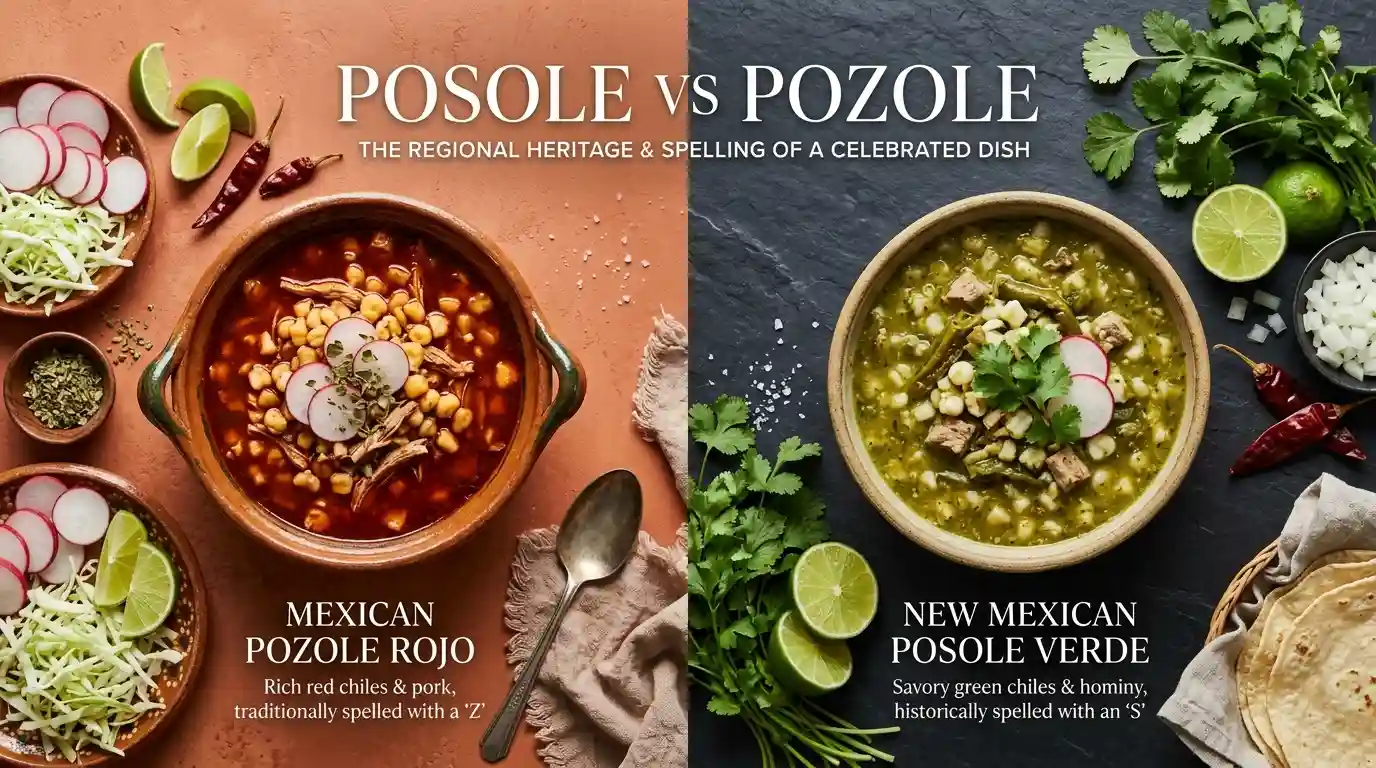
Posole and pozole are two spellings of the same hominy stew from Mexico. Pozole, with a z, is the Spanish spelling and the most common one. Posole, with an s, is a popular variant in New Mexico and the American Southwest.
Years ago, I stood in a Santa Fe market with a paper bowl in my hand. The sign on the stall said posole. I took a photo, because I was proud of my spelling. Then, a few months later, I ate in Guadalajara. The menu said pozole. Same soup. Different letter.
I am an English teacher. Spelling is my job. Yet I stood there and wondered which one I had been getting wrong.
The answer surprised me. I had not been wrong at all. Neither had the Santa Fe cook or the Guadalajara chef.
That is why you are here. You typed posole or pozole into a search bar because you saw both and wanted a straight answer. Maybe you are writing a menu. Maybe you are posting a recipe. Or maybe you just want to order dinner without second guessing yourself.
In this guide, you will learn what each spelling means, where each one comes from, and which one to use. You will also get cheat sheets, real examples, and quick answers to common questions. Let’s sort it out together.
Posole or Pozole: Quick Answer
Both spellings point to the same dish. It is a rich, warm stew made with hominy, which is dried corn treated with lime. Cooks usually add pork or chicken, chile, and fresh toppings.
The only real difference is one letter. Pozole uses a z. Posole uses an s.
Here are two simple examples:
- We ate a big bowl of pozole in Mexico City on a rainy night.
- My aunt in Albuquerque makes red chile posole every New Year’s Day.
Both sentences are correct. If you want one rule to remember, use this: choose pozole for general writing, and choose posole when you write about New Mexico style cooking.
What the dish actually is
Think of a soup that feels like a hug. The broth is deep and full of flavor. The hominy kernels are big, soft, and a little chewy. People add shredded cabbage, radish, lime, onion, and oregano on top.
You eat it at family parties, holidays, and celebrations. It is a food made for sharing.
The Origin and Background of Posole and Pozole
This dish is very old. It comes from the cooking traditions of Mexico, long before Spanish became the language of the region.
The word comes from Nahuatl, the language of the Aztec people. The Nahuatl word is usually written as pozolli. Many sources say it means “foamy” or “frothy.” Some link it to the way hominy kernels open up, or “bloom,” as they cook. The kernels burst and look a bit like flowers.
Why the spelling split happened
When Spanish speakers met Nahuatl words, they wrote them down using Spanish letters. The ending “olli” became “ole.” The sound in the middle became a z. So Spanish gave us pozole.
Then the dish traveled north. In New Mexico, Spanish and English mixed together over many years. Local spelling shifted. The z turned into an s, and posole became common there. In that region, the word often names both the stew and the hominy itself.
Why the confusion lasts
In Spanish, the letter z sounds like an s in most of Latin America. So the words sound the same when you say them out loud. Say “po SO leh” and you have said both.
That is the heart of the mix up. The ear hears one word. The eye sees two. Neither spelling is a typo. They are two paths from the same root.
Posole or Pozole Explained: Key Differences and Variations
Let’s put the terms side by side. This table gives you the full picture at a glance.
| Term | Meaning | When to Use | Region or Context |
| Pozole | Hominy stew, the standard Spanish spelling | Menus, recipes, general writing | Mexico, Latin America, most English recipe sites |
| Posole | Same stew, also the hominy itself | New Mexico style dishes, local menus | New Mexico, Colorado, Arizona, Southwest US |
| Pozolli | The old Nahuatl word | History and language writing | Nahuatl, pre Spanish Mexico |
| Pozol | A corn drink, not a stew | Writing about drinks from southern Mexico | Chiapas, Tabasco, southeast Mexico |
| Hominy | The corn kernels used in the dish | Ingredient lists | English speaking countries |
Examples for each form
Short examples help the rule stick. Read them out loud.
- Pozole: She served pozole rojo with a plate of crunchy tostadas.
- Posole: The diner on the plaza serves green chile posole on Fridays.
- Pozolli: The word pozolli appears in old Nahuatl records.
- Pozol: On a hot day, a cold cup of pozol hits the spot.
- Hominy: Soak the dried hominy overnight before cooking.
The three famous styles of pozole
The spelling is only half the story. The dish also comes in three popular colors.
- Pozole rojo: The red style. It uses dried red chiles. It is common in Jalisco and many other states.
- Pozole blanco: The white style. It has a clear broth and a pure, simple taste.
- Pozole verde: The green style. It uses green ingredients such as tomatillo and pumpkin seeds. It is often linked to Guerrero.
You will see all three on Mexican menus. In New Mexico, red chile and green chile posole are the stars.
Cheat Sheet One: The Spelling Snapshot
Cheat Sheet One: Posole or Pozole at a Glance
- Pozole with a z is the Spanish spelling. Use it for Mexican style recipes.
- Posole with an s is the Southwestern American variant. Use it for New Mexico style dishes.
- Both words name the same hominy stew.
- Both words sound almost the same when spoken.
- Pick one and stay with it for your whole piece.
Keep this list close. It answers most spelling questions in ten seconds.
Other spelling pairs that confuse people
Food words travel across languages, and spellings wobble. You may have met these pairs too.
| Spelling One | Spelling Two | Notes |
| pozole | posole | Both accepted, pozole is more common |
| jalapeno | jalapeño | The tilde is correct in Spanish, plain n is common in English |
| quesadilla | quesadia | Only the first is correct |
| guacamole | guacamol | Only the first is correct |
| chile | chili | Chile is the plant, chili can mean the stew |
Once you see the pattern, the fear fades. Posole and pozole are not special. They are one more pair in the story of how food words travel.
Which Version Should You Use?
You need a clear answer. So here it is. Match the spelling to your audience.
For general English readers
Use pozole. It is the standard Spanish spelling. Most cookbooks, food magazines, and recipe sites choose it. Your readers will know exactly what you mean.
For New Mexico and Southwest audiences
Use posole. Locals grew up with this spelling. A menu in Santa Fe that says pozole may look odd to some people there. Respect the local style.
For Mexican cooking and authentic recipes
Use pozole. If your recipe follows the traditions of Jalisco or Guerrero, the z shows respect for the source.
For students and exams
Use pozole. Teachers and style guides expect the Spanish spelling. If your teacher prefers another one, follow their guide.
For menus and restaurant branding
Use whichever one fits your kitchen and your region. Just stay consistent on every menu, sign, and website page.
The golden rule is consistency. Pick one spelling for your whole article, menu, or recipe book. Do not mix them.
Common Mistakes with Posole and Pozole
Most errors come from guessing. Here are the mistakes I see most often, with the fix beside each one.
| Mistake | Correction | Why It Happens |
| Pozzole | Pozole or posole | The writer doubles the z by habit, like in pizza |
| Pazole | Pozole | The vowel sounds blur when you say it fast |
| Posolé | Posole or pozole | The writer adds an accent that does not belong |
| Pozole and posole in one article | Choose one and keep it | The writer does not check for consistency |
| Pozol when you mean the stew | Pozole | The drink and the stew share a root |
Mistake one: thinking one spelling is wrong
This is the big one. Many people think posole is a typo. It is not. It is a real regional spelling with a long history. Please do not “fix” it in someone else’s work.
Mistake two: mixing both spellings
Imagine a recipe that says pozole in the title and posole in step four. Readers notice. It feels sloppy. Search your document for both forms before you publish.
Mistake three: confusing the stew with the drink
Pozol is a cold drink made from fermented corn dough. It is popular in southern Mexico. Pozole is the hot stew. They share a root, but they are not the same dish.
Mistake four: adding a stray accent
Spanish uses accents to mark stress, but this word does not need one. Write it plain. The stress falls on the middle syllable by itself.
Mistake five: calling it only a soup of meat
Some writers forget the star ingredient. The word points to the hominy. Without it, you simply have a pork stew.
Why these errors happen
Food names cross borders, and spelling rules do not always travel with them. We hear a word first and spell it second. Slow down, look at the letters, and say it aloud in three parts: po, so, le.
Posole and Pozole in Real World Examples
Let’s see how the word behaves in real situations. Notice how it fits naturally in each one.
In a professional email
Hi Maria, thank you for hosting us. The pozole at the team dinner was the highlight of the night. Could you share the recipe?
In a news headline
Local Chef Wins Regional Prize for Red Chile Posole
In a social media post
Cold night, big pot, family around the table. Nothing beats homemade pozole on the first day of winter. #comfortfood
In a formal report
The study notes that pozole, a hominy based stew, remains a central dish at holiday gatherings across several Mexican states.
In a restaurant menu
Green Chile Posole: slow cooked pork, hominy, roasted green chile, served with warm tortillas.
In a cookbook note
Soak the hominy overnight. This step makes the pozole tender and keeps the broth clear.
Look at how smoothly each one reads. The spelling fits the setting. That is what good writing does.
Posole or Pozole: Data, Trends and Usage
People search this pair all the time. The two spellings look equally real, so readers want a referee.
Who searches for it
Home cooks, students, food bloggers, and restaurant owners search for this the most. Readers in the United States show strong interest, especially in states close to Mexico. Many Spanish speakers and English learners also check the spelling online.
When interest rises
Interest tends to rise during cold months and around big celebrations. Many families make the stew for Christmas Eve, New Year’s Day, and Mexican Independence Day in mid September. For a live look, you can use Google Trends and compare both spellings across years and regions.
Search intent
The intent here is informational. The reader wants a quick and trusted answer. They are not ready to buy anything. They want to fix a menu, finish a recipe post, or settle a debate at the dinner table.
Why this matters right now
Here is one fresh insight. More people than ever cook Mexican and Southwestern food at home. Recipe blogs, video channels, and food delivery menus all show these words in front of millions of readers. A spelling choice now shapes how your page ranks, how your menu looks, and how your brand feels.
If your readers search for pozole and you only write posole, you may miss them. A smart writer picks one main spelling and mentions the other once for clarity. That is exactly what a good guide should do.
Standalone Comparison Table
Here is the full comparison in one place. Save it for later.
| Term or Variant | Meaning | Region or Context | Best Used When |
| Pozole | Hominy stew | Mexico, Latin America, global recipe sites | You want the most common, standard spelling |
| Posole | Hominy stew and the hominy itself | New Mexico and the Southwest | You write for local readers or New Mexico style food |
| Pozole rojo | Red chile hominy stew | Jalisco and many Mexican states | You describe the red style |
| Pozole verde | Green hominy stew | Guerrero and nearby regions | You describe the green style |
| Pozole blanco | White, clear broth stew | Across Mexico | You describe the simple, plain style |
| Pozol | Corn drink | Chiapas and Tabasco | You write about the drink, not the stew |
Words that sit close to this dish
Sometimes you need a helper word. Here are terms that often appear next to posole or pozole:
- Hominy: corn kernels soaked in lime water, which makes them soft and puffy
- Nixtamalization: the old method of treating corn with lime
- Mote: a word used for boiled corn in parts of Latin America
- Menudo: another famous Mexican stew, made with tripe
- Caldo: the Spanish word for broth
- Tostada: a crisp tortilla served on the side
Use these when you want to add depth to a recipe or a food story.
Cheat Sheet Two: The Fast Decision Guide
Print this or screenshot it. It will save you time.
Cheat Sheet Two: Which Spelling Do I Pick?
- Writing a general recipe or blog post? Pozole.
- Writing about New Mexico food or a local menu? Posole.
- Writing about the old Aztec word? Pozolli.
- Writing about a corn drink? Pozol.
- Unsure about anything else? Pozole.
And a three step check before you hit publish:
- Search your text for “posole.”
- Search your text for “pozole.”
- Keep only one of them, unless you mention the other on purpose to explain.
Cheat Sheet Three: Say It Right
Spelling is easier when you can say the word. Try this.
Cheat Sheet Three: Pronunciation
- Break it into three parts: po, so, le.
- Put the stress on the middle part: po SO le.
- The last letter sounds like the “e” in “bed,” not like a long “ee.”
- The z in pozole sounds like an s in most Spanish speaking regions.
If you say it this way in a Mexican or New Mexican restaurant, people will understand you right away.
Frequently Asked Questions
Q: What does posole or pozole mean?
A: Both words name a traditional Mexican stew made with hominy, meat, and chile. The word comes from the Nahuatl term pozolli, often translated as foamy or frothy. The meaning is the same for each spelling.
Q: How do you use pozole correctly in a sentence?
A: Treat it like any other food noun. For example, “We ordered a bowl of pozole” or “The pozole was rich and spicy.” Add the color for clarity, such as pozole rojo or pozole verde.
Q: Posole vs pozole: what is the difference?
A: There is no difference in the dish. The only change is the letter. Pozole is the Spanish and most common spelling. Posole is a popular variant in New Mexico and the Southwest.
Q: Is posole acceptable in formal writing?
A: Yes, it is accepted, especially when you write about New Mexico cuisine. Still, pozole is the safer choice for formal work, because it matches the Spanish spelling and most cookbooks.
Q: Which version is correct, posole or pozole?
A: Both are correct. Pick pozole if you want the standard form. Pick posole if your region or audience prefers it, and then stay consistent.
Q: Where does the word pozole come from?
A: It comes from the Nahuatl word pozolli, used by the Aztec people. Spanish speakers adapted it into pozole. The spelling later shifted to posole in parts of the American Southwest.
Q: Can pozole be used for drinks, not just food?
A: No, not quite. The stew is pozole. A related corn drink from southern Mexico is called pozol, without the final e. Keep the two words separate so your readers do not get confused.
Conclusion
You now know the truth about posole or pozole. Let’s wrap up the key points.
First, both spellings are correct. Second, pozole with a z is the standard Spanish spelling and the most common choice. Third, posole with an s is a fine regional variant, especially for New Mexico style food. Fourth, the two words sound almost the same, which is why the confusion lasts.
My final advice is simple. Use pozole for most writing. Use posole when your audience or your region calls for it. And whichever you choose, keep it the same from the first line to the last.
That bowl in Santa Fe taught me something. A spelling question is never silly. It shows a writer who cares about people and their food. And caring about words is how good writing begins.
So go ahead and use the word with confidence. Bookmark this guide so you never second guess posole or pozole again. And share it with a friend who is still wondering which one is right.
Read More: Loveable or Lovable: The Real Spelling Answer

Hey, I’m Ayeza. I started wordiums.com because I kept freezing over words that look almost the same, unsure which one was right. Now I explain every word comparison in plain language, so you can pick the right word with confidence and move on.