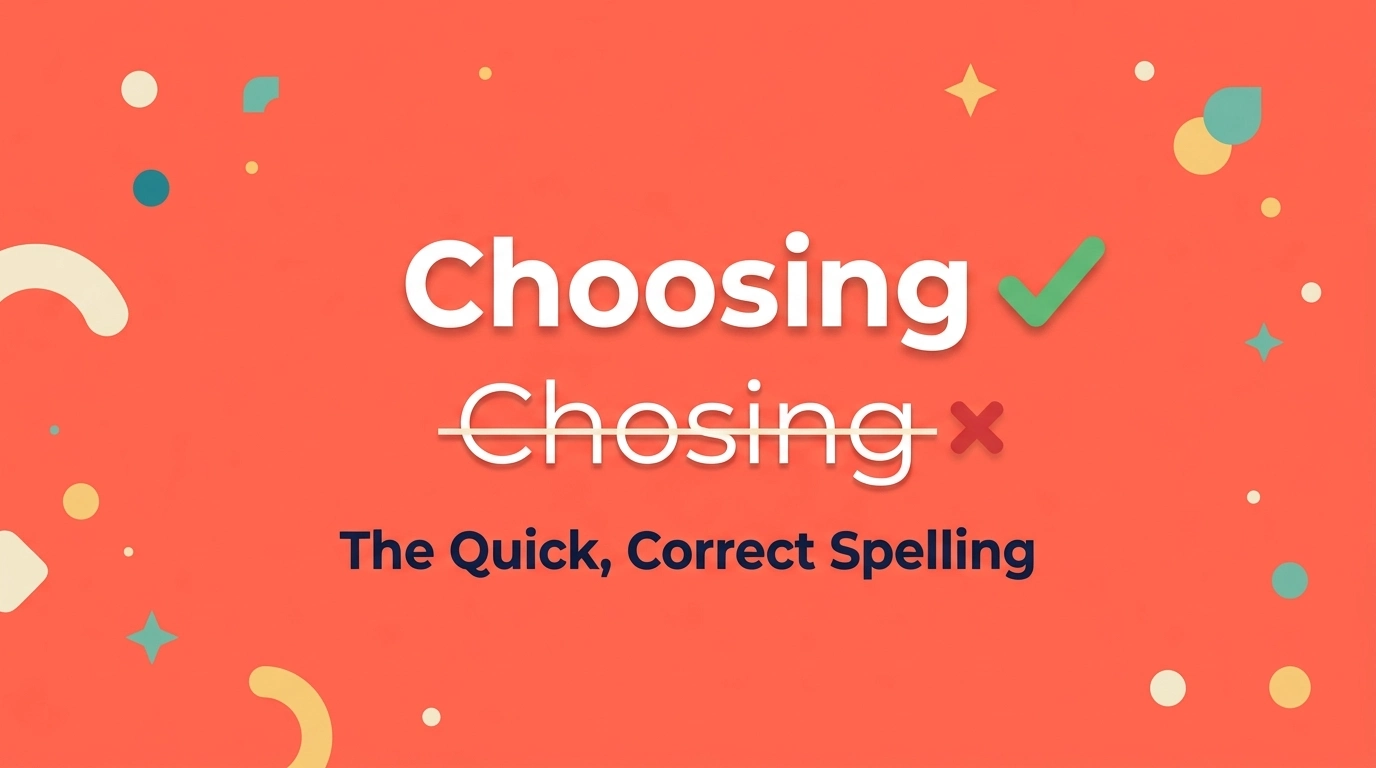
Choosing is the correct spelling. Chosing is a common mistake.
A few years ago, I was marking a pile of student essays. One title stopped me: “Chosing the Right College.” I smiled, because I had written the very same word on a sticky note the week before.
The mistake is easy to make. You know the past tense is chose. So you add ing and get chosing. It looks neat. It feels logical. It is also wrong.
That is why you searched chosing or choosing. You wanted a straight answer, and you probably wanted it before you hit send.
In this guide, you will see the correct spelling, the simple rule behind it, and how to avoid the mix up with chose and chosen. You will also get two cheat sheets you can save. Let’s fix this in a few minutes.
Chosing or Choosing: Quick Answer
Only one spelling is correct. It is choosing.
The base word is choose, with two o’s. When you add ing, you drop the silent e and keep both o’s. That gives you choosing.
Two examples:
- I am choosing a new laptop this weekend.
- Choosing a major is a big decision.
One memory trick: choosing has two o’s, like zoo. If you see only one o, something is wrong.
Why the Confusion Happens
Three forms of this verb look alike, so writers mix them up.
- Choose is the base form (I choose tea).
- Chose is the past tense (I chose tea yesterday).
- Chosen is the past participle (I have chosen tea).
The word chosing blends the past tense chose with the ending ing. It feels right, but English does not build the ing form from the past tense. It builds it from the base form.
The word has old roots. Choose comes from Old English ceosan, a Germanic verb. The noun choice came into English later through Old French. The sound changed over time, and the spelling stayed with the double o.
Chosing or Choosing Explained: Key Forms
Here is the whole word family in one place. Read each line out loud.
- Choose: the base form. Example: You can choose any seat.
- Chooses: present tense for he, she, it. Example: She chooses the blue one.
- Choosing: the ing form, for actions in progress. Example: We are choosing a name.
- Chose: past tense. Example: He chose the shorter road.
- Chosen: past participle, used with have, has, had or was. Example: She was chosen for the team.
- Choice: the noun. Example: It was a hard choice.
- Choosy: an adjective for someone who is picky. Example: My cat is very choosy.
Notice something useful. Only choosing and choose keep the double o. Chose and chosen have one o.
Cheat Sheet One: The Silent E Rule
Cheat Sheet One: Adding ing to words that end in e
- If a word ends in a silent e, drop the e and add ing.
- Choose becomes choosing.
- Use becomes using. Lose becomes losing. Move becomes moving.
- Words that end in ee or oe keep the e, as in seeing and canoeing.
- Never build the ing form from the past tense. Not chose plus ing.
This rule solves hundreds of spelling questions, not just this one.
Which Version Should You Use?
Use choosing every time. It is the only correct spelling, so there is no regional choice to make.
- Students and teachers: use choosing. Exam markers treat chosing as a spelling error.
- Professionals writing emails or reports: use choosing. A small error in a subject line is easy to avoid.
- Bloggers and content writers: use choosing. Search engines and readers both expect it.
- Global or neutral writing: use choosing. It is correct in American, British, Canadian and Australian English.
There is one tiny exception. A brand or a person might spell a name in a creative way. In that case, copy the spelling exactly as given.
Common Mistakes with Choosing
Here are the errors I see most often. Each one shows the mistake first and then the fix.
- Chosing should be choosing. It happens because writers add ing to chose.
- Choosen should be chosen. It happens because writers add en to the base form.
- I have chose should be I have chosen. It happens because chose and chosen sound close.
- I am choose should be I am choosing. It happens when the ing is forgotten.
- Choosey is a rare variant of choosy. Choosy is the more common spelling, so use it.
Many spellcheckers miss the second and third mistakes. Both chose and chosen are real words, so the tool may not warn you. Read your sentence out loud to catch them.
Choosing in Real World Examples
In a professional email
Hello Team, we are choosing a new project tool this week. Please send your suggestions by Friday.
In a news headline
Why More Families Are Choosing Smaller Homes
In a social media post
Choosing a favorite movie from my list is impossible. Help! #movienight
In a formal report
The panel spent three days choosing the final candidates from a list of forty applicants.
Each example uses the ing form for something happening now or over a period of time. That is the main job of this word.
Chosing or Choosing: Data, Trends and Usage
People search this pair because the wrong spelling looks believable. The searchers are mostly students, English learners, bloggers and office workers who want to check before they publish.
The intent is informational. The reader wants a fast, trusted answer.
Why does it matter today? Writing happens quickly on phones, in chats and in documents with autocomplete. Tools help, but they do not catch every grammar slip. If you know the rule, you do not need to depend on a tool. You can fix the word and the sentence yourself.
Standalone Comparison Table
Here is the whole picture in a short list format. Save it for later.
- Choosing
- Meaning: picking something now or over time
- Context: all English, all writing
- Best used when: you describe an action in progress
- Chosing
- Meaning: none, it is a misspelling
- Context: none
- Best used when: never
- Chose
- Meaning: picked in the past
- Context: all English
- Best used when: you talk about a finished choice
- Chosen
- Meaning: picked, used after have, has, had or was
- Context: all English
- Best used when: you need a past participle
- Choice
- Meaning: an option, or the act of picking
- Context: all English
- Best used when: you need a noun
Cheat Sheet Two: Choose, Chose, Chosen, Choosing
Cheat Sheet Two: Which form do I need?
- Now or every day: choose. I choose to walk.
- Right now, in progress: choosing. I am choosing a gift.
- Yesterday or earlier: chose. I chose a gift yesterday.
- With have, has, had or was: chosen. I have chosen a gift.
- A thing you pick: choice. It was a great choice.
If you still feel unsure, put the sentence in the past and see if it still makes sense.
Frequently Asked Questions
Q: What does choosing mean?
A: Choosing means picking one option from two or more. It describes the action while it is happening.
Q: How do you use choosing correctly?
A: Use it after a form of be, as in am, is, are, was or were. Example: She is choosing a dress.
Q: Chosing vs choosing: what is the difference?
A: There is no difference in meaning, because chosing is not a real word. Choosing is the correct spelling.
Q: Is chosing ever acceptable in formal writing?
A: No. It is always a spelling error. Use choosing in every kind of writing.
Q: Which version is correct, chosing or choosing?
A: Choosing is correct. Remember that it keeps both o’s from the base word choose.
Q: Where does choosing come from?
A: It comes from the verb choose, which goes back to the Old English word ceosan. The ing ending makes it the present participle.
Q: Can choosing be used as a noun?
A: Yes. It can work like a noun in some sentences, as in “Choosing is hard.” Here the word names the act itself.
Conclusion
You now know how to settle chosing or choosing. The correct spelling is choosing. It keeps both o’s from choose and drops the silent e before ing. The word chose is the past tense, chosen is the past participle, and neither one is the base for the ing form.
My advice is simple. Say the base word first. Choose becomes choosing, just as use becomes using. That small habit will protect your writing from this mistake and many others.
Bookmark this guide so you never second guess chosing or choosing again. And share it with a friend who still writes it the old way.
Read More: Sergeant or Sargeant: The Real Spelling Explained

Hi, I’m Zara. Words that look almost identical but mean different things have always fascinated me, and that is what pulled me into writing about spelling and usage. Every guide gives you the answer first, then explains it clearly enough that you won’t need to look it up again.