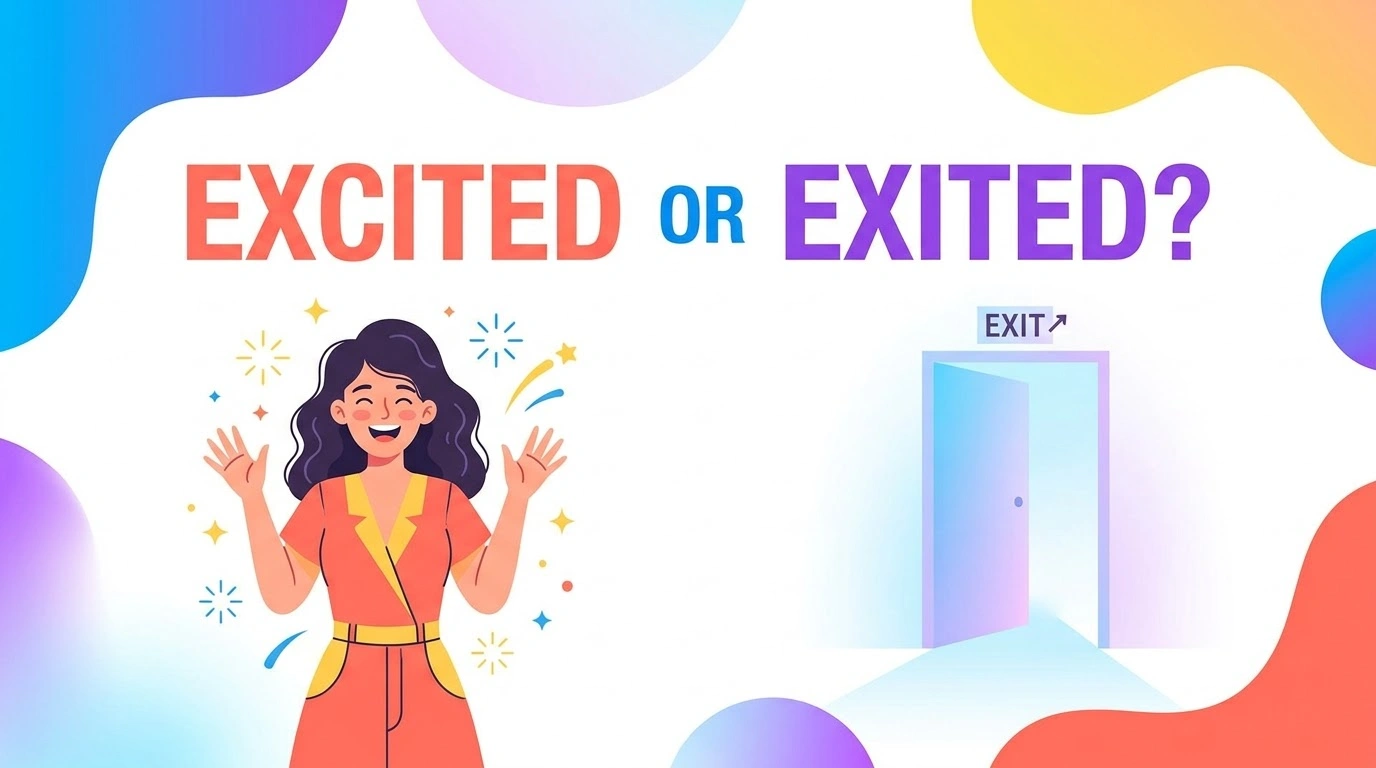
Excited or exited? Pick by meaning.
- 🎉 Excited = a happy, eager feeling
- 🚪 Exited = left a place, job, or program
- 🔑 Memory trick: C is for cheer, X is for exit
Here is a mistake that slips past almost every spell checker. Someone writes, “I am exited to join your team.” The sentence looks fine at a glance. Yet the writer just said they left the team.
I have seen this slip in cover letters and emails more times than I can count. It happens to smart people. The reason is simple: exited is a real word, so no red line ever appears.
Maybe you are proofreading a message right now. Or you are learning English, and the two words look like twins. Either way, you want a clear answer, fast.
This guide gives you one. You will learn what each word means, where each one comes from, and how to use it with confidence. Three cheat sheets and real examples you can copy are in here too.
Ready to stop mixing them up for good? Let us start with the basics.
Excited or Exited: Quick Answer
Excited describes a feeling. You feel eager, happy, or full of energy. Exited describes an action. You left a place, a job, or a program.
Here are two examples:
- “The kids were excited about the school trip.”
- “The kids exited the bus one by one.”
Same letters, almost. Very different jobs.
The Origin of Excited and Exited
Both words come from Latin. Excited grows from excitare, which means to rouse or stir up. Picture waking someone with a burst of energy.
Exited comes from the Latin exire, which means to go out. It began as a stage direction in plays, telling an actor to leave the stage. Over time, it became an everyday word for leaving any place.
So why do people confuse them? There are three simple reasons:
- They share the same first two letters.
- They both end in ited.
- Fast typing drops the letter c very easily.
One missing letter turns joy into leaving.
Excited or Exited Explained: Key Differences
Think of it this way. Excited is about how you feel inside. Exited is about where you go. Exciting is about the thing that makes you feel something.
| Term | Meaning | When to Use | Region or Context |
| Excited | Feeling eager, happy, or full of energy | To describe a feeling | All English, everyday and formal |
| Exited | Left a place, a job, or a system | To describe leaving | All English, common in news and business |
| Exciting | Causing excitement | To describe the thing that thrills you | All English |
Notice that each word answers a different question. Excited asks, “How do you feel?” Exited asks, “What did you leave?”
Cheat Sheet: 3 Easy Ways to Pick the Right Word
Save these three tricks. They work every time.
Cheat Sheet 1: The Letter Trick
- C is for cheer. Excited has a c.
- X is for exit. Think of the X on an exit sign.
Cheat Sheet 2: The Swap Test
Replace your word with a simple one. Then see what fits.
- Does thrilled fit? Use excited. (“I am thrilled to see you.”)
- Does left fit? Use exited. (“She left the room.”)
Cheat Sheet 3: Word Partners
- Excited about a thing: “excited about the party.”
- Excited to do something: “excited to start.”
- Excited for an event: “excited for Friday.”
- Exited a place, job, or program: “exited the building.”
Which Word Should You Use?
Pick based on who you are and what you are writing.
- For students: use excited for feelings and exited for leaving. Run the swap test before you hand in homework.
- For job seekers: use excited in cover letters. “Excited to apply” sounds warm and normal. Check this word twice before you hit send.
- For business writers: use exited when you mean left or sold. It is common in company news.
- For social media: use excited. Share the feeling, and your friends will cheer with you.
- For global or neutral use: excited for feelings, exited for leaving. These rules do not change by country.
Common Mistakes with Excited or Exited
Here are five slips that come up again and again.
1. Wrong: “I am so exited for my trip.”
Right: “I am so excited for my trip.”
Why it happens: The c goes missing, and spell check stays quiet.
2. Wrong: “The actors excited the stage.”
Right: “The actors exited the stage.”
Why it happens: The words look alike, so the eye skips the difference.
3. Wrong: “She exitted the room.”
Right: “She exited the room.”
Why it happens: Some words double the last letter, like submitted. Exit does not, because the stress falls on the first part of the word. It keeps one t.
4. Wrong: “I am exicted.”
Right: “I am excited.”
Why it happens: Fingers swap the c and the i when you type fast.
5. Wrong: “The movie was very excited.”
Right: “The movie was very exciting.”
Why it happens: Excited describes the person. Exciting describes the thing that causes the feeling.
Excited or Exited in Real World Examples
Seeing the words in action makes the rule stick.
A professional email:
“Hello Maria, I am excited to join the marketing team next month.”
A news headline:
“Founder Exited Startup After Record Sale”
A social media post:
“So excited for the weekend! Who is coming to the concert? 🎉”
A formal report:
“The fund exited its position in the second quarter.”
Look at how the meaning changes the whole sentence. Feelings get excited. Leaving gets exited.
Excited or Exited: Usage, Trends, and Why It Matters
Search numbers change every month, so I will not quote any here. For live data, check Google Trends in your country. What stays steady is the reason people search.
They are proofreading. Emails, cover letters, texts, and posts all need a final check. Then a doubt hits: did I type the right word?
The search intent is informational. Readers want a fast, clear answer. English learners may also look it up, since the words look so alike.
One insight matters right now. Autocorrect and spell check will not save you. Exited is a real word, so it passes the test. Only your own eyes can catch the slip. Messages go out in seconds, so a one letter mistake can travel far.
Excited or Exited Comparison Table
| Term or Variant | Meaning | Region or Context | Best Used When |
| Excited | Feeling eager or happy | All English | You describe how a person feels |
| Exited | Left a place, job, or program | All English, common in business and tech | You describe leaving |
| Exciting | Causing eager feelings | All English | You describe a thing, event, or news |
| Existed | Was real or alive | All English | You describe something that is or was real |
FAQ
Q: What does excited or exited mean?
A: They are two different words. Excited means eager and happy. Exited means left or went out.
Q: How do you use excited correctly?
A: Use it for feelings. Say “excited about” a thing, “excited to” do something, or “excited for” an event.
Q: What is the difference between excited and exciting?
A: Excited describes the person who feels the thrill. Exciting describes the thing that causes it. You are excited about an exciting trip.
Q: Is exited acceptable in formal writing?
A: Yes. Exited is correct when you mean left. It is common in business and news. Just never use it to mean a happy feeling.
Q: Which version is correct, “I am excited” or “I am exited”?
A: “I am excited” is correct for a feeling. “I am exited” is almost always a typo.
Q: Where do excited and exited come from?
A: Both come from Latin. Excited comes from excitare, to rouse. Exited comes from exire, to go out.
Conclusion
Here is what to remember. Excited is a feeling. Exited is leaving. Exciting is the thing that causes the feeling. Keep these three apart, and you will stay safe.
When you feel unsure, use the cheat sheets. The letter trick is quick: C is for cheer, X is for exit. Even stronger is the swap test: try thrilled or left, and the right word appears.
My advice is simple. Read this word twice before you send any message. Spell check will not catch it for you, so your eyes must. A quick pause costs two seconds. One wrong word can cost you a good first impression, especially in a cover letter or a work email.
You now know exactly how to choose between excited or exited. Bookmark this guide so you never second guess it again. Better yet, share it with someone who has been confused about excited or exited. They will thank you.
Read More: Preformed or Performed: The Simple Way to Choose

My name is Ayesha Sadiqah, the writer behind this website. I write in-depth articles on English spelling, word comparisons, grammar, and vocabulary to help learners make better language choices. Every guide is designed to provide accurate, practical, and easy-to-understand information.