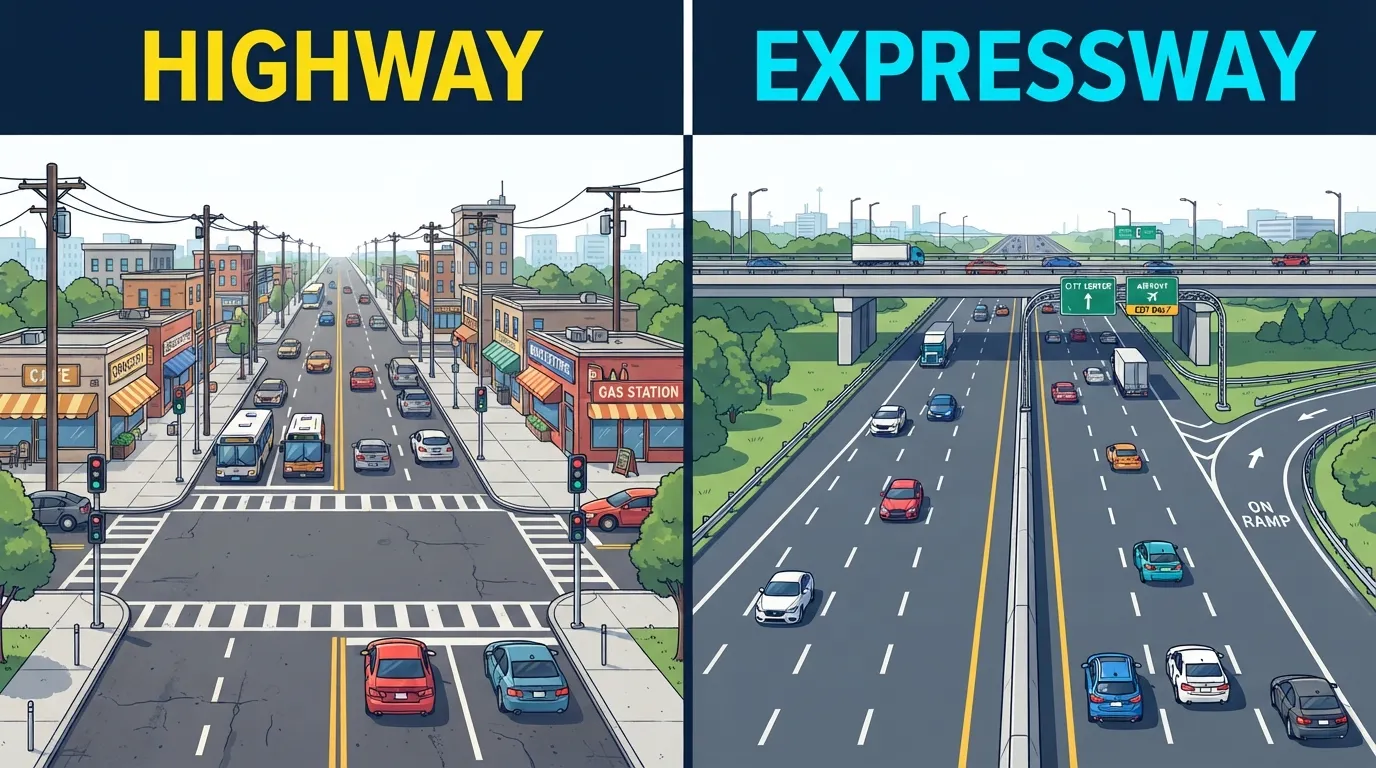
Highway is a broad term for any major public road connecting cities or regions, while expressway refers specifically to a controlled access, high speed road built for fast, uninterrupted travel.
On a long road trip a few years ago, my GPS suddenly announced that I was merging onto an expressway, right after I had spent the last hour on what it called a highway. I remember thinking they felt exactly the same to me, just wide roads with fast cars. Later, I learned there actually is a meaningful difference between the two, one that matters for drivers, city planners, and anyone writing about transportation.
Highway and expressway often get used casually as synonyms, but they describe roads with different design standards and access rules. This article explains where each term came from, how they differ in practice, and which one applies to the road you are actually describing. By the end, you will never confuse these terms again.
Highway or Expressway, Quick Answer
Highway is a general term for any major public road built to connect towns, cities, or regions, and it can include roads with intersections, traffic signals, and varying speed limits. Expressway specifically means a road designed for continuous high speed travel, usually with limited entry and exit points and no traffic signals.
For example, a two lane road connecting small towns might be called a highway, while a multi lane road with on ramps and off ramps built purely for fast travel would be called an expressway.
The Origin of Highway and Expressway
Highway comes from Old English, combining the word high, meaning main or principal, with way, meaning road or path. It originally referred simply to the main public road used for travel between places, without any specific design standard attached.
Expressway is a much newer term, developed in the twentieth century alongside the rise of automobile travel and modern road engineering. It combines express, meaning fast and direct, with way, describing a road built specifically for rapid, uninterrupted movement.
This history explains why highway remains a broad, flexible term, while expressway carries a more specific, modern engineering meaning tied to controlled access design.
Highway or Expressway, Key Differences and Regional Use
| Term | Meaning | When to Use | Region or Context |
| Highway | Any major public road connecting towns or regions | General road references, government transportation naming, everyday driving talk | Common across American, British, and international English |
| Expressway | High speed, controlled access road with limited entry points | Describing modern fast travel infrastructure, city planning, engineering documents | Common in the United States and parts of Asia, sometimes replaced by motorway in the United Kingdom |
A useful example: the term motorway is common in the United Kingdom for controlled access roads, while expressway is more common in American cities and several Asian countries for the same type of road.
Which Version Should You Use?
Use highway when referring broadly to any significant road connecting places, especially in general conversation, road trip planning, or basic transportation writing.
Use expressway when specifically describing a road built for continuous, high speed travel with limited access points, particularly in urban planning, engineering, or detailed transportation content.
For international content, remember that regional terms vary. Motorway, freeway, and expressway can all describe similar controlled access roads depending on the country, so match your terminology to your audience.
Common Mistakes with Highway and Expressway
Mistake: Assuming every highway has controlled access like an expressway. Correction: Many highways include intersections, traffic signals, and varying speeds, unlike a true expressway.
Mistake: Using expressway for any wide, fast road. Correction: Expressway specifically implies limited entry and exit points designed for continuous travel, not just wide lanes.
Mistake: Treating highway and expressway as identical in every country. Correction: Regional naming varies significantly, so a controlled access road might be called motorway, freeway, or expressway depending on location.
Mistake: Assuming expressway always means a toll road. Correction: Tolls depend on specific regional infrastructure decisions, not on the word expressway itself.
Mistake: Writing highway when referring to a small local street. Correction: Highway refers to significant roads connecting larger areas, not minor residential streets.
Highway or Expressway in Real World Examples
Professional email: “Construction crews will close two lanes on the expressway starting Monday morning.”
News headline: “State Highway Department Announces Funding for Regional Road Repairs.”
Social media post: “Traffic on the expressway is absolutely brutal today, avoid it if you can.”
Formal report: “The proposed route follows the existing highway before merging onto the new expressway extension.”
These examples show expressway appearing in contexts focused on speed and controlled traffic flow, while highway appears in broader, general road references.
Highway or Expressway, Data and Trends
Search interest in expressway often centers around specific cities and regions with well known controlled access systems, particularly in parts of Asia and major American metropolitan areas. Highway searches remain broader and more consistent, often tied to travel planning, government transportation news, and general road information.
This distinction matters for content targeting local audiences, since some regions strongly prefer expressway in official naming, while others rely almost entirely on highway or motorway instead.
Highway or Expressway Comparison Table
| Term or Variant | Meaning | Region or Context | Best Used When |
| Highway | General major public road | Global, broad usage | Referring to any significant connecting road |
| Expressway | Controlled access, high speed road | United States, parts of Asia | Referring specifically to fast, limited access roads |
Frequently Asked Questions
Q: What does highway mean compared to expressway? A: Highway is a general term for major public roads, while expressway specifically describes a controlled access road built for continuous high speed travel.
Q: How do you use highway and expressway correctly? A: Use highway for general road references and expressway when specifically describing limited access, fast travel roads with restricted entry points.
Q: Highway vs expressway, what is the real difference? A: The key difference is access control. Highways can include intersections and signals, while expressways are built for uninterrupted, high speed travel.
Q: Is expressway acceptable in formal writing? A: Yes, expressway is standard terminology in transportation engineering, urban planning, and official government road naming.
Q: Which version is correct, highway or expressway? A: Both are correct, but they describe different types of roads. The right choice depends on whether the road has controlled access.
Q: Where does the word expressway come from? A: Expressway developed in the twentieth century, combining express, meaning fast, with way, describing a road built for rapid travel.
Q: Can highway be used to describe a controlled access road? A: Yes, highway can broadly include expressways, since expressway is technically a specific type of highway with stricter design standards.
Final Thoughts
Highway and expressway both describe major roads, but they are not perfectly interchangeable once you look at design and access. Highway remains a broad, flexible term for significant connecting roads, while expressway specifically means a controlled access road built for continuous, high speed travel.
Use highway for general references and expressway when precision about road design matters. Bookmark this guide so you always choose the right term, and share it with anyone who still mixes up highway and expressway.
Read More: Sceptical or Skeptical: Clearing Up the Confusion for Good

Hi, I’m Zara. Words that look almost identical but mean different things have always fascinated me, and that is what pulled me into writing about spelling and usage. Every guide gives you the answer first, then explains it clearly enough that you won’t need to look it up again.