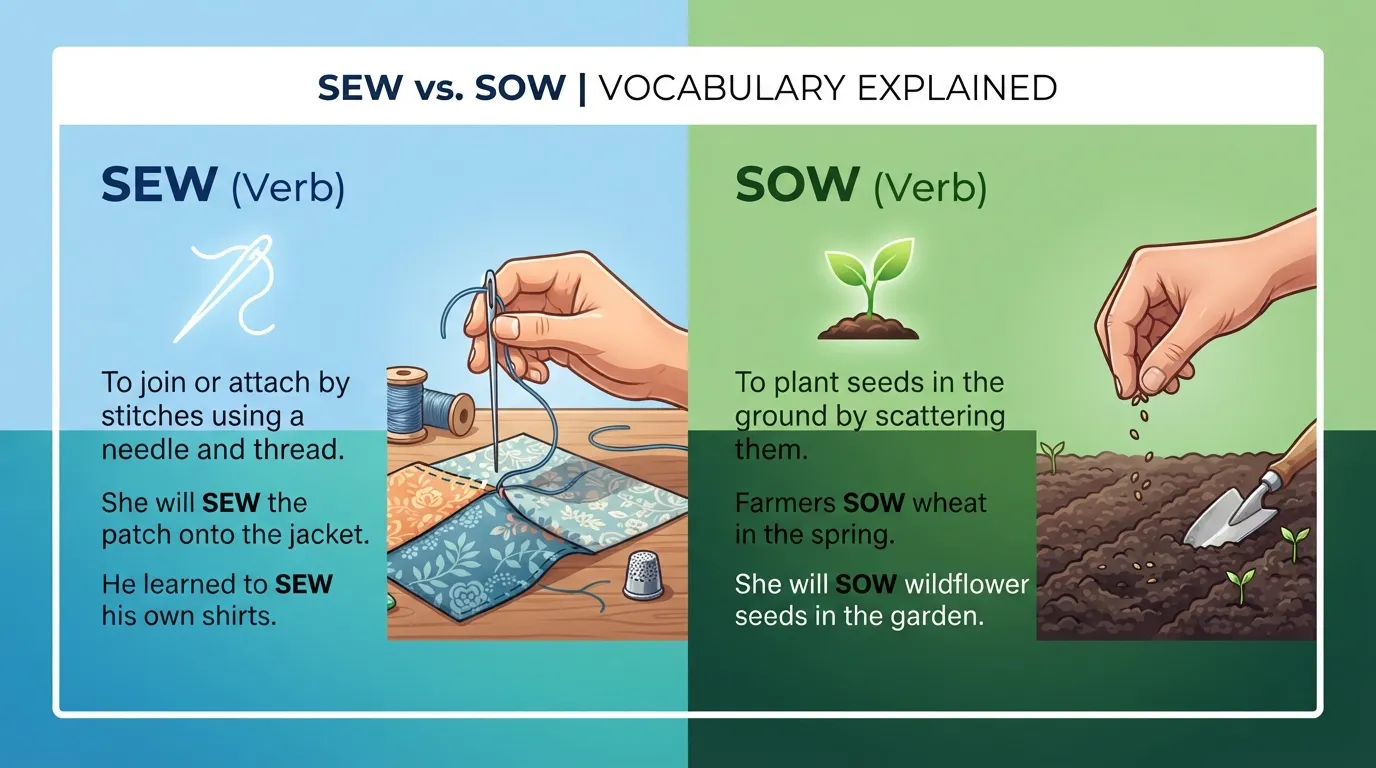
Sew means to stitch fabric together with a needle and thread. Sow means to plant seeds in the ground. They sound alike but describe completely different actions.
I once texted a friend “I need to sow a button back on my shirt,” and she sent back a laughing emoji before correcting me. I had known both words my whole life, yet somehow my fingers picked the wrong one without thinking.
This mix up happens constantly, mostly because sew and sow sound almost identical when spoken aloud, even though they mean completely different things. One belongs in a sewing kit, and the other belongs in a garden.
This guide breaks down exactly what separates these two words, where each one came from, and how to keep them straight permanently. By the end, you will never send an awkward text about sowing a button again.
Homophones like this trip up even confident writers, since spelling rules alone will not save you here. You need a clear mental picture tied to each word, and this guide will give you exactly that.
Sew or Sow – Quick Answer
Sew means to join or repair fabric using a needle and thread. Example: “She sewed a patch onto his jacket.”
Sow means to plant seeds in soil, usually for growing crops or flowers. Example: “They sow wheat every spring.”
A simple trick: sew rhymes with “go,” and both involve using your hands to create something. Sow rhymes with “grow,” and both are directly connected to plants and growth.
The Origin of Sew and Sow
Sew comes from the Old English word siwian, meaning to stitch or fasten with thread. This root connects to a much older Proto Indo European word related to binding or fastening things together, a concept that appears across many ancient languages.
Sow comes from the Old English word sawan, meaning to scatter seed. This word also traces back to a shared ancient root, one connected to the act of throwing or scattering, which perfectly describes how seeds get spread across a field.
Both words are genuinely ancient, appearing in some of the earliest recorded English texts. They never shared a common root with each other, despite sounding so similar today. Their identical pronunciation is simply a coincidence created by how English vowel sounds evolved over many centuries.
Interestingly, sow also has a second, completely unrelated meaning as a noun, referring to a female pig. That version is pronounced differently, rhyming with “cow” instead of “grow,” which adds yet another layer to this confusing little word family.
Sew and Sow Explained: Key Differences
| Term | Part of Speech | Meaning | Example |
| Sew | Verb | To stitch fabric with needle and thread | I need to sew this hem before tomorrow. |
| Sow | Verb | To plant seeds in the ground | Farmers sow corn in early spring. |
Notice that both words are verbs describing hands on, physical actions, which is part of why they get confused so easily in casual writing. But the actions themselves could not be more different.
Here is a quick mental test. If your sentence involves fabric, needles, thread, or clothing repair, you want sew. If your sentence involves seeds, soil, planting, or gardening, you want sow.
- I will sew the torn seam tonight. (fabric and thread)
- We sow tomato seeds in April. (seeds and soil)
Which Version Should You Use?
For crafting and clothing topics, always use sew. This applies to tailoring, quilting, costume making, and any hands on textile work involving needle and thread.
For gardening and agriculture topics, always use sow. This covers planting seeds, farming practices, and even figurative expressions about planting ideas.
For figurative expressions, sow appears often in phrases like “sow the seeds of doubt” or “you reap what you sow,” where the planting metaphor extends beyond literal gardening.
For everyday speech, context almost always makes the correct word obvious, but written text loses that spoken clarity, which is exactly why this pair causes so many typing mistakes.
If you are ever unsure while writing quickly, pause and picture the actual physical action happening. Needle and thread means sew. Seeds and soil means sow.
Common Mistakes with Sew and Sow
Mistake 1: Writing “I need to sow a button” instead of “I need to sew a button.” Why it happens: the words sound identical when spoken, so the wrong spelling slips through during fast typing.
Mistake 2: Writing “We sewed seeds in the garden” instead of “We sowed seeds in the garden.” Why it happens: writers default to the more commonly typed word, sew, without pausing to consider the actual meaning.
Mistake 3: Confusing sow the verb with sow the noun, meaning a female pig. Why it happens: the spelling stays identical between the verb and the unrelated noun, even though the pronunciation changes completely.
Mistake 4: Using “sown” and “sewn” interchangeably as past participles. Why it happens: both follow similar irregular patterns, sew becomes sewn, and sow becomes sown, which makes the two forms easy to mix up under pressure.
Mistake 5: Assuming both words share a common origin because they sound alike. Why it happens: people naturally assume similar sounding words are related, but sew and sow developed from entirely separate root words in Old English.
Sew and Sow in Real World Examples
In a professional email: “Our tailoring team can sew custom alterations within three business days.”
In a news headline: “Local Farmers Sow Early This Year Amid Mild Spring Weather”
In a social media post: “Spent my whole Saturday learning to sew my own tote bags, so proud of this one.”
In a formal document: “Instructions specify farmers should sow seeds no deeper than two centimeters.”
Each example places the correct word inside a context that matches its true meaning, fabric and stitching for sew, seeds and soil for sow.
Related Words That Cause Similar Confusion
Sew and sow are not the only homophones that trip up writers in this exact way. English has several word pairs that sound alike but describe entirely unrelated actions, and recognizing the pattern helps with all of them.
Sole and soul sound identical but describe a shoe part and a spiritual concept, similar to how sew and sow describe fabric work and planting despite sharing no meaning.
Wear and where create similar confusion, especially for fast typists, since context alone often has to carry the weight of clarifying meaning in quick writing.
Flour and flower follow the exact same pattern as sew and sow, two completely unrelated concepts sharing identical pronunciation purely by coincidence of English sound history.
Building a habit of pausing on homophones like these, picturing the actual physical object or action involved, works well across all of these tricky word pairs, not just sew and sow specifically.
Sew and Sow in Idioms and Figurative Language
Sow shows up frequently in figurative English, far beyond literal gardening. Phrases like “sow the seeds of change” or “you reap what you sow” use planting as a metaphor for actions that grow into larger consequences later.
These idioms rely entirely on the correct spelling to make sense visually. Writing “you reap what you sew” breaks the metaphor completely, since the image only works when tied to seeds and growth, not needle and thread.
Sew appears in far fewer idioms by comparison, though phrases like “sew things up,” meaning to finish or secure something completely, do exist and carry a completely different image, tied to closing or fastening rather than growth.
Recognizing these idiomatic uses gives you another clue when deciding between the two words. If your sentence carries a metaphorical sense of consequences growing from earlier actions, sow is almost always the correct choice.
A Quick Cheat Sheet for Sew and Sow
Keep this simple reference nearby whenever you are writing about crafting, gardening, or anything involving these two tricky homophones, so you never have to pause and second guess yourself again.
- Use sew for needle, thread, fabric, mending, and clothing related writing.
- Use sow for seeds, soil, planting, farming, and figurative growth expressions.
- Remember sewn as the past participle of sew, describing finished stitching work.
- Remember sown as the past participle of sow, describing seeds already planted.
- Picture the physical action happening in your sentence before choosing either word.
This short reference works well for crafters, gardeners, writers, and anyone drafting content that touches on either topic, since the visual test rarely fails once you build the habit.
Sew or Sow: Final Thoughts
Homophones like sew and sow exist all throughout English, and they rarely disappear from a language once they take root, since spoken language cares far less about spelling than written language does.
The good news is that context almost always makes the intended meaning obvious once you slow down and actually picture what is happening in the sentence you are writing or reading.
Whether you spend your weekends mending clothes or planting a garden, this small distinction will keep your writing clear, accurate, and free of any accidental, slightly funny mental images involving sewn tomato seeds.
Sew and Sow: Data, Trends and Usage
Search interest in “sew or sow” comes from two very different audiences searching for entirely different reasons, crafters looking up sewing terms and gardeners researching planting techniques. It falls under informational search intent, since both groups want quick, reliable confirmation before they write.
Interest in sow spikes seasonally, particularly in early spring, when gardening searches surge across the board. Interest in sew stays more consistent year round, tied closely to hobby crafting trends and seasonal clothing repairs.
Content creators covering hobbies, gardening blogs, and craft tutorials search this pair often, since a single wrong word in a tutorial title can confuse readers or hurt search rankings entirely.
This distinction matters because these two audiences rarely overlap, yet the words themselves look and sound similar enough that even experienced writers occasionally second guess their spelling.
Standalone Comparison Table
| Term | Meaning | Region or Context | Best Used When |
| Sew | To stitch fabric with needle and thread | Crafting, tailoring, textile work | Describing sewing, mending, or fabric work |
| Sow | To plant seeds in soil | Gardening, farming, agriculture | Describing planting or figurative growth |
Frequently Asked Questions
Q: What does sew mean? A: Sew means to join or repair fabric using a needle and thread, such as sewing a button, hemming pants, or making a quilt.
Q: What does sow mean? A: Sow means to plant seeds in the ground, typically for growing crops, flowers, or vegetables, and it also appears in figurative expressions about planting ideas.
Q: Sew vs sow, what is the actual difference? A: Sew relates to fabric and stitching, while sow relates to planting seeds. They sound alike but come from completely unrelated Old English root words.
Q: Is sow acceptable in formal writing? A: Yes, sow is standard in formal writing about agriculture, gardening, and figurative expressions, such as academic texts discussing farming practices.
Q: Which version is correct, sew or sow, when talking about fabric? A: Sew is correct for fabric. If your sentence involves needles, thread, or clothing repair, sew is always the right choice.
Q: Where do sew and sow come from? A: Sew comes from the Old English siwian, meaning to stitch. Sow comes from the Old English sawan, meaning to scatter seed. They developed separately despite their similar sound today.
Q: Can sow refer to something other than planting? A: Yes, sow can also be a noun referring to a female pig, though it is pronounced differently in that sense, rhyming with cow rather than grow.
Q: How do you remember the difference between sew and sow? A: Picture the physical action. Sew rhymes with go and involves needle and thread. Sow rhymes with grow and involves seeds going into soil.
Conclusion
Sew and sow sound almost identical, but they describe two completely different actions rooted in two completely different parts of daily life. Sew belongs with needle, thread, and fabric. Sow belongs with seeds, soil, and growth.
Keep the simple mental picture in mind whenever you write either word. Fabric and stitching mean sew. Seeds and planting mean sow. That single image will settle almost every case of hesitation you run into.
Homophones like this one catch even careful writers off guard, but now you have a clear, lasting way to tell them apart without second guessing yourself.
Now you know exactly how to use sew or sow correctly, every single time you write. Bookmark this guide so you never mix them up again, and share it with anyone who has ever sewed a seed by mistake.
Read More: Congratulation or Congratulations: The Correct Way to Say It

Hi, I’m Zara. Words that look almost identical but mean different things have always fascinated me, and that is what pulled me into writing about spelling and usage. Every guide gives you the answer first, then explains it clearly enough that you won’t need to look it up again.