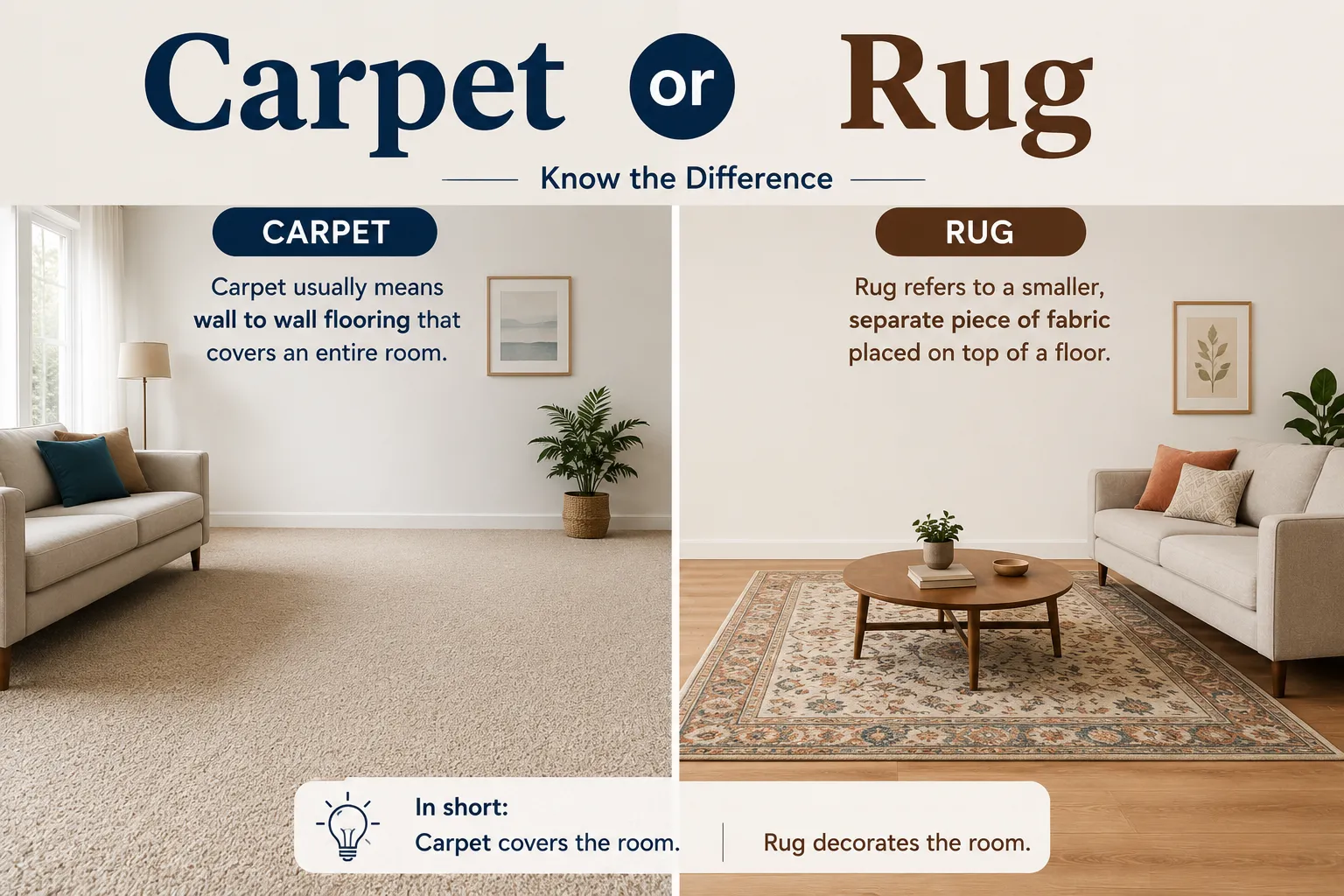
Carpet usually means wall to wall flooring that covers an entire room, while rug refers to a smaller, separate piece of fabric placed on top of a floor.
My aunt once asked me to help her pick a new carpet for her bedroom, then handed me a photo of a small woven mat she wanted placed near her bed. I gently pointed out that what she wanted was actually a rug. She laughed and admitted she never really understood the difference. That conversation stuck with me, because so many people use these two words as if they mean the exact same thing.
They do not. Carpet and rug share a similar purpose, covering floors and adding comfort underfoot, but they differ in size, installation, and even history. This article walks through where each word came from, how they differ today, and which one you should use depending on what you actually mean. By the end, you will know exactly when to say carpet and when to say rug.
Carpet or Rug, Quick Answer
Carpet typically refers to flooring material that gets fixed permanently across an entire room, often glued or tacked down. Rug refers to a smaller, movable textile placed on top of an existing floor, whether that floor is wood, tile, or carpet itself.
For example, a homeowner might install beige carpet throughout a bedroom, then place a colorful rug near the closet for extra texture.
The Origin of Carpet and Rug
Carpet comes from the Old French word carpite, which traces further back to Latin roots connected to plucking or carding wool. Historically, carpet described any thick fabric covering, including table coverings, before it became specifically tied to flooring.
Rug likely comes from a Scandinavian source, possibly Old Norse, originally meaning rough or coarse cloth, often used as a blanket or covering before it settled into meaning a small floor covering.
Both words evolved over centuries, but modern usage has sorted them into fairly clear roles based on size and permanence rather than fabric type.
Carpet or Rug, Key Differences and Regional Use
| Term | Meaning | When to Use | Region or Context |
| Carpet | Wall to wall flooring, usually installed permanently | Home renovation, real estate, flooring industry | Common across American and British English equally |
| Rug | Smaller, portable floor covering placed on top of existing flooring | Interior decor, accent pieces, portable furnishing | Common globally, often used interchangeably with area rug |
A helpful example: a hotel lobby might have marble flooring with a large decorative rug placed at the entrance, while the guest rooms upstairs might have soft carpet covering the entire floor.
Which Version Should You Use?
Choose carpet when describing flooring that covers the entire floor and is fixed in place, especially in real estate listings, renovation guides, or flooring product descriptions.
Choose rug when describing a smaller, standalone textile that someone can pick up, move, or replace easily, particularly in interior design content or shopping guides.
For global or neutral writing, both terms work fine as long as you match the correct object. If confusion is possible, use the phrase area rug for extra clarity, since it removes any ambiguity about size.
Common Mistakes with Carpet and Rug
Mistake: Calling a small decorative floor piece a carpet. Correction: Use rug for smaller, movable pieces, even if they cover a large section of a room.
Mistake: Using rug to describe wall to wall flooring. Correction: Use carpet for permanently installed, full room flooring.
Mistake: Assuming carpet and rug are made from different materials. Correction: Both can be made from wool, synthetic fiber, or natural fiber. Material does not determine the correct word.
Mistake: Thinking rug only refers to small entryway mats. Correction: Rugs can be quite large, including oversized area rugs that cover most of a living room floor.
Mistake: Writing carpet when referring to something you can roll up and move. Correction: If it can be rolled and relocated, it is a rug, not a carpet.
Carpet or Rug in Real World Examples
Professional email: “We recommend replacing the hallway carpet before the property showing next week.”
News headline: “Artisan Rug Makers See Rising Demand from Younger Homeowners.”
Social media post: “Just found the perfect rug for my reading corner.”
Formal report: “The living space includes full carpet flooring with one accent rug near the fireplace.”
These examples show a clear pattern. Carpet appears when discussing permanent flooring projects, while rug appears when discussing decor choices or portable furnishings.
Carpet or Rug, Data and Trends
Search interest for rug tends to rise around home decor seasons, particularly when people redecorate living rooms or bedrooms with smaller budget updates. Carpet searches often connect to renovation projects, real estate preparation, and larger home improvement decisions.
This distinction matters for content creators and retailers. A furniture brand selling small decorative pieces should target rug related keywords, while a flooring company focused on full room installations should target carpet related keywords.
Carpet or Rug Comparison Table
| Term or Variant | Meaning | Region or Context | Best Used When |
| Carpet | Permanent, wall to wall flooring | Renovation, real estate, flooring industry | Describing full room flooring installation |
| Rug | Movable, smaller floor covering | Interior decor, accent furnishing | Describing a standalone decorative floor piece |
Frequently Asked Questions
Q: What does carpet mean compared to rug? A: Carpet refers to flooring that covers an entire room and is usually installed permanently, while rug refers to a smaller piece placed on top of any floor.
Q: How do you use carpet and rug correctly? A: Use carpet for full room, fixed flooring and rug for smaller, movable floor coverings, including large area rugs.
Q: Carpet vs rug, what is the real difference? A: The main difference is size and permanence. Carpet is fixed and covers the whole floor, while rug sits on top of any surface and can be moved easily.
Q: Is rug acceptable in formal writing? A: Yes, rug is standard, correct English and appears regularly in interior design writing, real estate listings, and formal decor descriptions.
Q: Which version is correct, carpet or rug? A: Both are correct, but they describe different objects. The right word depends on whether the item is fixed flooring or a portable textile.
Q: Where does the word carpet come from? A: Carpet comes from Old French carpite, connected to Latin roots about plucking or working wool into thick fabric.
Q: Can rug be used to describe something that covers a whole room? A: Yes, if it is not permanently fixed. A very large area rug can cover most of a room and still remain a rug rather than a carpet.
Final Thoughts
Carpet and rug both describe soft floor coverings, but they are not interchangeable once you look closely. Carpet means permanent, wall to wall flooring, while rug means a smaller, portable textile placed on top of a floor.
Use carpet when writing about flooring installation and renovation. Use rug when writing about decor, accent pieces, or portable furnishings. Bookmark this guide so you never mix up carpet and rug again, and share it with anyone still confused about the two.
See More: Yep or Yup: Which One Should You Actually Use?

I’m Zain. Through Wordiums.com, I write clear, accurate word comparison guides that show the difference between similar words, spellings, and phrases, so readers can choose the right word in seconds.