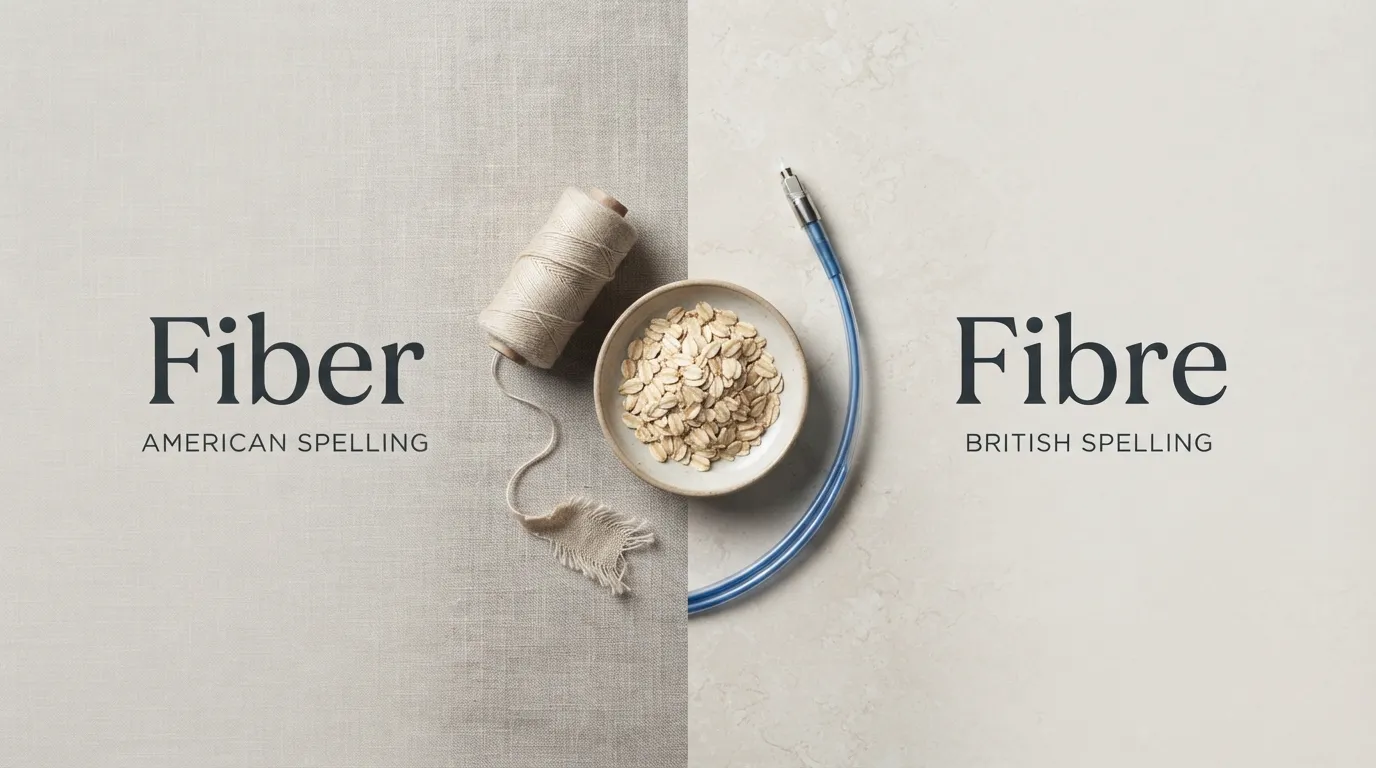
Fiber and fibre mean the exact same thing. Fiber is the American spelling, while fibre is the British spelling. Both refer to a thread like strand of material, whether it is the food kind you eat or the material kind used in cables and fabric.
I still remember standing in a grocery store in Toronto, staring at a cereal box that read “high fibre content” while my American cousin held up a nearly identical box back home that said “high fiber.” Same product. Same company. Two completely different spellings.
That moment sent me down a rabbit hole. Why does one word split into two spellings? Is one wrong? Does it matter for schoolwork, business writing, or online content?
Turns out, millions of people search this exact question every month. Students get marked down for “wrong” spelling that is actually just regional. Writers second guess themselves mid sentence. Companies selling international products worry about which version to use on packaging.
This guide clears up the confusion once and for all. You will learn where each spelling comes from, when to use each one, and how to avoid the small mistakes that make writing look inconsistent. By the end, you will never pause over this word again.
Let us get into it.
Fibre or Fiber: Quick Answer
Both spellings point to the same concept. A fiber, or fibre, is a thin strand of natural or synthetic material. It can describe cotton threads, optical cables, or the plant material in your diet that keeps your digestion healthy.
The only real difference is geography. Fiber is used in the United States. Fibre is used in the United Kingdom, Canada, Australia, and most Commonwealth countries.
For example, an American nutrition label says “dietary fiber,” while a British one says “dietary fibre.” Both describe the same nutrient.
The Origin of Fiber and Fibre
The word traces back to the Latin term fibra, meaning a thread or filament. It entered English through French, which kept the ending closer to the original Latin form.
British English generally preserved many French influenced spellings from the era when French was the language of the English court and educated classes. That is why British English still uses centre, theatre, and fibre.
American English took a different path in the early nineteenth century. Lexicographer Noah Webster wanted American spelling to be simpler and more phonetic. He pushed for center, theater, and fiber because they matched how the words actually sound when spoken.
This single decision by one influential figure created a permanent split that still shapes writing across the globe today. Neither version is more correct historically. They simply evolved along separate paths after splitting from the same French and Latin roots.
Webster published his dictionary in 1828, and it slowly reshaped how an entire nation wrote. Schools adopted his spellings, newspapers followed, and within a few generations, fiber felt as natural to Americans as fibre still felt to the British.
Meanwhile, across the Atlantic, British publishers kept the older spelling intact. Dictionaries like the Oxford English Dictionary preserved fibre as the standard, and colonial expansion carried that spelling to Canada, Australia, India, and dozens of other nations that adopted British English as their foundation.
This is why, even today, a Canadian student writing an essay is taught fibre, while their neighbor just across the border in the United States learns fiber in the exact same grade level. The border between countries quietly became a border between spellings too.
Interestingly, some Canadian institutions blend both systems depending on the context, leaning toward British spelling in government writing while allowing more flexibility in casual or American influenced media. This blend makes Canada one of the more interesting cases when studying how spelling habits spread and shift over time.
Fibre Explained: Key Differences and Variations
While the core meaning never changes, context can shift how each spelling gets used. Here is a breakdown of common variations.
| Term | Meaning | When to Use | Region or Context |
| Fiber | Thread like strand or dietary nutrient | American writing, US publications | United States |
| Fibre | Thread like strand or dietary nutrient | British writing, formal documents | UK, Canada, Australia, most Commonwealth nations |
| Fiber optic | Cable technology using light signals | Technology and telecom writing | Mostly American spelling, used globally in tech |
| Fibre optic | Cable technology using light signals | Same technology, different spelling | British and Commonwealth tech writing |
| Fiberglass | Composite material made of fine glass strands | American product naming | United States |
| Fibreglass | Composite material made of fine glass strands | British product naming | UK and Commonwealth countries |
Notice that even compound words like fiberglass follow the same regional pattern. If the base word changes, the compound word changes with it.
Which Version Should You Use?
This is where most people get stuck. The answer depends entirely on your audience.
For American readers, always use fiber. This includes US based blogs, American companies, and any content targeting a US audience for search engines like Google.com.
For British, Canadian, or Australian readers, use fibre. Government documents, UK news outlets, and Commonwealth businesses expect this spelling.
For a global or neutral audience, pick one spelling and stay consistent throughout the entire piece. Search engines and readers both notice when a document mixes fiber and fibre in the same paragraph. It signals sloppy editing, even though neither word is technically wrong.
If you write for an international company, check their style guide first. Many global brands standardize on American English simply because it dominates search volume and business communication.
Common Mistakes With Fiber and Fibre
Even confident writers slip up here. Below are the most frequent errors.
Mistake 1: Mixing spellings in one document Wrong: “This fiber rich diet includes fibre from vegetables.” Correct: “This fiber rich diet includes fiber from vegetables.” Why it happens: Writers switch between American and British sources while researching, and the inconsistency slips through unnoticed.
Mistake 2: Assuming one spelling is universally correct Wrong belief: “Fiber is the only correct spelling because it is more common online.” Correct understanding: Fibre is fully correct and standard in British English. Popularity does not equal correctness.
Mistake 3: Misspelling fiberoptic or fibreoptic as one word incorrectly Wrong: “fibreoptik” or “fiberoptik” Correct: “fiber optic” or “fibre optic,” usually written as two words or with a space, depending on the style guide.
Mistake 4: Using the wrong spelling in product names Wrong: Selling “Fiberglass Insulation” in a UK online store without adjusting for local buyers. Correct: Adjust product listings to “Fibreglass Insulation” for UK marketplaces to match local search habits and reduce confusion.
Mistake 5: Forgetting spell check regional settings Many writers leave their word processor set to the wrong regional dictionary, causing autocorrect to silently change fibre to fiber or the reverse. Always confirm your language settings before submitting formal work.
Fiber and Fibre in Real World Examples
Seeing the word in context makes the distinction click faster.
Professional email, American English: “Please find attached our updated fiber optic installation schedule for the Chicago office.”
News headline, British English: “Broadband Providers Race to Expand Fibre Networks Across Rural Villages”
Social media post, American English: “Started adding more fiber to my breakfast this week and honestly feel so much better already.”
Formal document, British English: “The report outlines fibre consumption trends among adults aged eighteen to thirty five across the United Kingdom.”
Notice how the surrounding vocabulary stays neutral, but the spelling itself instantly signals which audience the writer had in mind.
Fiber and Fibre: Data, Trends and Usage
Search data consistently shows fiber earning higher global search volume, largely because the United States has a much larger English speaking online population. However, fibre still dominates search results within the UK, Canada, Australia, Ireland, and South Africa.
Health and nutrition content sees massive search interest for both spellings, especially around topics like dietary fiber benefits, fiber supplements, and high fibre foods. This falls under informational search intent, meaning people want to learn something rather than buy something immediately.
Telecom and internet providers also drive heavy search traffic for fiber optic internet in the US and fibre broadband in the UK, which leans more commercial since users are often comparing service providers.
This regional split matters more than ever as companies expand globally. Getting the spelling right for a specific market can meaningfully improve how trustworthy and localized your content feels to readers.
Marketing teams who ignore this detail often see subtle drops in engagement. A British shopper who lands on a page filled with American spelling might still understand every word, but something feels slightly off, almost like reading a translated document. That small friction can quietly lower trust and conversion rates.
Search engines have also grown smarter about regional intent. A search for fibre broadband in London will often surface local providers using the British spelling, while the same search typed as fiber broadband from a US location returns entirely different results. This is a strong reminder that spelling is not just a grammar choice, it is also a targeting decision that affects visibility.
Content creators who publish for a global audience sometimes solve this by creating two versions of key pages, one using American spelling and one using British spelling, each optimized for its own regional search traffic. While this takes extra effort, it often pays off for larger websites competing in both markets at once.
Comparison Table: Fiber vs Fibre
| Term or Variant | Meaning | Region or Context | Best Used When |
| Fiber | Thread strand or dietary nutrient | United States | Writing for American audiences |
| Fibre | Thread strand or dietary nutrient | UK, Canada, Australia | Writing for Commonwealth audiences |
| Fiber optic | Light based cable technology | US tech industry | American tech and telecom content |
| Fibre optic | Light based cable technology | UK and Commonwealth tech industry | British tech and telecom content |
Frequently Asked Questions
Q: What does fiber or fibre mean? A: Both words describe a thin thread like strand of material. This can refer to plant based nutrients in food, threads in fabric, or strands used in cables like fiber optic lines.
Q: How do you use fiber or fibre correctly? A: Match the spelling to your audience. Use fiber for American readers and fibre for British or Commonwealth readers, and stay consistent throughout your writing.
Q: Fiber vs fibre, what is the real difference? A: There is no difference in meaning. The only difference is regional spelling convention, with fiber used in the US and fibre used in most other English speaking countries.
Q: Is fibre acceptable in formal writing? A: Yes, fibre is completely acceptable and standard in formal British, Canadian, and Australian writing, including academic papers and government publications.
Q: Which spelling is correct, fiber or fibre? A: Both are correct. Correctness depends entirely on which regional English standard you are following, not on the word itself.
Q: Where does the word fiber come from? A: It comes from the Latin word fibra, meaning thread or filament, which passed into English through French influence centuries ago.
Q: Can fiber and fibre be used interchangeably online? A: Yes for meaning, but not for consistency. Search engines and readers respond better when a single spelling is used consistently across a page or website.
Final Thoughts
Fiber and fibre are twins separated by an ocean, not two different words with different meanings. The spelling you choose simply signals which audience you are writing for.
Remember these key takeaways. Fiber belongs to American English. Fibre belongs to British and Commonwealth English. Neither spelling beats the other in correctness. Consistency within a single document matters more than which version you pick.
Next time you write about nutrition, cables, or fabric, choose your spelling with your reader in mind, then stick with it from start to finish.
Bookmark this guide so you never second guess fiber or fibre again, and share it with a colleague who still mixes the two.
Read More: Steel or Steal: How to Never Confuse These Words Again

My name is Ayesha Sadiqah, the writer behind this website. I write in-depth articles on English spelling, word comparisons, grammar, and vocabulary to help learners make better language choices. Every guide is designed to provide accurate, practical, and easy-to-understand information.