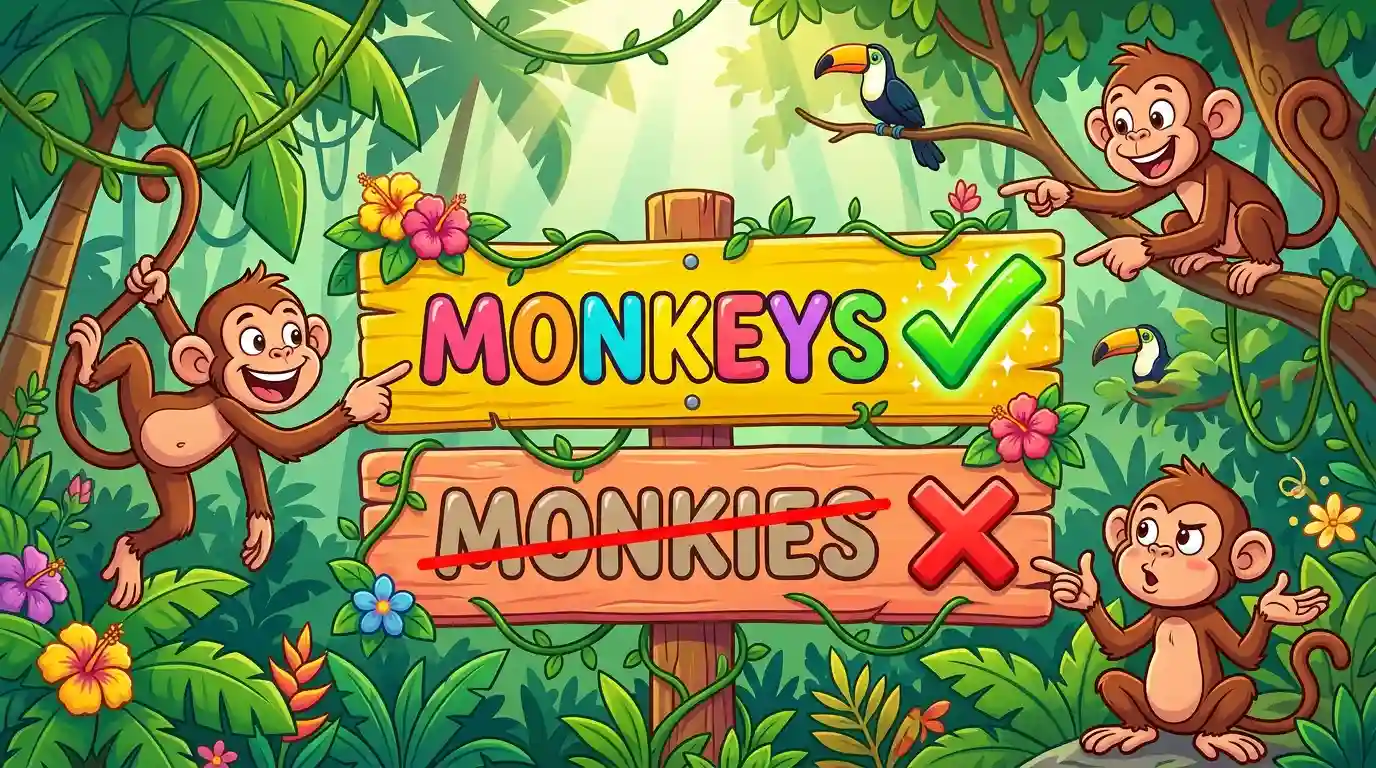
Monkeys or monkies? Monkeys is the only correct plural of monkey. Monkies is a common misspelling. When a word ends in a vowel plus y, you just add s. Say “one monkey, two monkeys,” and you will be right every time.
I still remember a school trip to a small city zoo. A hand painted sign hung above one cage. It said “Monkies House.”
I was the teacher in charge that day. My pen was already out, because the habit of marking errors never leaves you. I stopped halfway. Was I about to correct a sign that every child would read?
A student beside me asked, “Miss, is that spelled right?” I did not have a quick, confident answer. I had to think about it.
That moment is common. Many people write “monkies” without noticing. The word looks natural. It even feels right, because we know that baby becomes babies and pony becomes ponies.
This guide clears up the doubt. You will learn the simple rule behind the plural, why the wrong spelling feels so tempting, and how to avoid it for good. You will also get three cheat sheets, real examples, and clear answers to common questions.
Ready to fix this once and for all? Let us begin.
Monkeys or Monkies: Quick Answer
Monkeys is correct. It is the plural of the noun monkey. It also works as a verb form, as in “He monkeys with the radio.”
Monkies is not a standard English word. It is a spelling mistake that comes from applying the wrong plural rule.
Here are two quick examples:
- The monkeys at the sanctuary shared a pile of fruit.
- Three monkeys climbed the old fig tree.
Both sentences are correct. There is no region or style that accepts “monkies.”
The One Line Memory Trick
Look at the letter before the y. In monkey, that letter is e, a vowel. A vowel before y means you keep the y and add s.
So: monkey becomes monkeys. Day becomes days. Key becomes keys.
The Origin and Background of Monkeys or Monkies
The word monkey has a mysterious past. Dictionary writers do not agree on where it came from. One popular idea links it to an old European story about a clever animal trickster, where a character had a name close to “Moneke.” Other experts say the origin is simply uncertain.
What we do know is that the word entered English around the sixteenth century. Since then, English speakers have used it for the long tailed, tree climbing animals we all recognize.
The plural was never “monkies.” English has always formed it with a plain s. The word follows the same pattern as many other everyday nouns that end in ey.
Why the Confusion Exists
There are three main reasons people write “monkies.”
First, English has a famous rule for words that end in y. When a consonant comes before the y, you change the y to ies. That is why baby becomes babies, puppy becomes puppies, and city becomes cities. Many learners apply that rule to every word with a y.
Second, the word money has a plural that looks like “monies.” Some writers use monies in finance and law. Because money and monkey both end in ey, the pattern seems to carry over. It does not, because monkey follows the regular vowel rule.
Third, spell checkers are not always strict. If a program has a custom dictionary, or if you are typing fast on a phone, “monkies” may slip through unnoticed.
How They Sound
Say the plural out loud. Monkeys sounds like “MUNG keez.” The last sound is a long “ee” followed by a z sound.
“Monkies” would sound almost the same. That is the trap. You cannot hear the difference, so you must remember the rule.
Monkeys or Monkies Explained: Key Differences or Variations
Only one of these spellings is correct. But the monkey word family has several forms, and some of them trip people up too. Here is a quick map.
| Term | Meaning | When to Use | Region or Context |
| Monkey | One animal of this type | Talking about a single animal | Used worldwide |
| Monkeys | More than one monkey | Talking about two or more animals | Used worldwide |
| Monkies | A misspelling | Never in standard writing | Not accepted anywhere |
| Monkey’s | Belongs to one monkey | “The monkey’s tail was long.” | Used worldwide |
| Monkeys’ | Belongs to several monkeys | “The monkeys’ cage was clean.” | Used worldwide |
| Monkeyed | Past form of the verb monkey | “He monkeyed with the lock.” | Used worldwide |
| Monkeying | Ongoing form of the verb monkey | “Stop monkeying around.” | Used worldwide |
Examples for Each Form
- Monkey: A monkey grabbed the banana and ran.
- Monkeys: Monkeys live in forests, mountains, and grasslands.
- Monkey’s: The monkey’s fur was thick and brown.
- Monkeys’: The monkeys’ favorite snack is fresh fruit.
- Monkeyed: Someone monkeyed with the thermostat overnight.
- Monkeying: The kids kept monkeying around in the back seat.
Cheat Sheet 1: The Y Rule
This rule solves the entire puzzle. Save it.
| Ending of the Word | What to Do | Example |
| Vowel plus y | Keep the y, add s | monkey becomes monkeys |
| Vowel plus y | Keep the y, add s | key becomes keys |
| Vowel plus y | Keep the y, add s | boy becomes boys |
| Vowel plus y | Keep the y, add s | donkey becomes donkeys |
| Consonant plus y | Change y to ies | baby becomes babies |
| Consonant plus y | Change y to ies | pony becomes ponies |
| Consonant plus y | Change y to ies | city becomes cities |
The vowels are a, e, i, o, and u. If one of them sits right before the final y, you do not change the word. You add an s and you are done.
Cheat Sheet 2: Words That Behave Like Monkey
If you can spell these plurals, you can spell monkeys.
| Singular | Correct Plural | Wrong Plural |
| monkey | monkeys | monkies |
| donkey | donkeys | donkies |
| turkey | turkeys | turkies |
| journey | journeys | journies |
| valley | valleys | vallies |
| chimney | chimneys | chimnies |
| kidney | kidneys | kidnies |
| jockey | jockeys | jockies |
Notice that every wrong plural in the third column ends in “ies” after a vowel. That is the pattern to avoid.
Which Version or Approach Should You Use?
Here is direct advice for each kind of reader.
- For students, use monkeys because that is the only form teachers and exam boards accept. Remember the vowel rule and you will get it right under pressure.
- For bloggers and content writers, use monkeys because search engines and readers expect it. A wrong spelling in a headline can hurt trust.
- For teachers and parents, use monkeys and teach the Y Rule alongside it. Children learn faster when one rule explains many words.
- For business and marketing writers, use monkeys in every brand message. If your product has a playful name, such as a cartoon or logo, check that the plural still follows the rule.
- For global or neutral use, choose monkeys. It is correct in American, British, Canadian, Australian, Indian, and Pakistani English.
Cheat Sheet 3: The Fast Decision Guide
Ask yourself two questions:
- What letter comes right before the y? If it is a vowel, add s.
- Does the word sound like a plain animal or object noun? Then it probably just takes s.
If you are still unsure, the answer for monkey is always monkeys.
Common Mistakes with Monkeys or Monkies
Even careful writers slip here. Let us look at the five most common errors.
Mistake 1: Changing the y to ies
- Wrong: The monkies are in the tree.
- Right: The monkeys are in the tree.
Why it happens: The writer remembers the baby to babies rule and uses it on every y word. But that rule is only for a consonant before the y.
Mistake 2: Using an apostrophe for a plain plural
- Wrong: Three monkey’s sat on the fence.
- Right: Three monkeys sat on the fence.
Why it happens: Many people think an apostrophe helps show a plural. It does not. An apostrophe shows ownership, not number.
Mistake 3: Mixing up the possessive forms
- Wrong: The monkeys cage was cleaned today.
- Right: The monkeys’ cage was cleaned today.
Why it happens: The writer forgets that a plural noun that already ends in s takes the apostrophe after the s when it shows ownership. For one monkey, write monkey’s. For many monkeys, write monkeys’.
Mistake 4: Misspelling the past tense
- Wrong: The children monkied around all afternoon.
- Right: The children monkeyed around all afternoon.
Why it happens: Writers apply the “change y to i” rule again. But after a vowel, the y stays, so the past form is monkeyed.
Mistake 5: Borrowing the band name spelling
- Wrong: The Monkees are climbing trees at the zoo.
- Right: The monkeys are climbing trees at the zoo.
Why it happens: The famous 1960s American pop group, The Monkees, chose a playful spelling on purpose. That spelling belongs to the band. For the animal, always use monkeys.
Monkeys or Monkies in Real World Examples
Let us see the correct word at work in different settings.
In a Professional Email
“Hi Dr. Rahman, the monkeys in the second enclosure have recovered well. I will send the health report on Friday. Thanks, Sara.”
In a News Headline
“Rare Monkeys Return to Forest Reserve After Ten Years”
In a Social Media Post
“Spent the morning watching monkeys play near the waterfall. Best start to a weekend ever!”
In a Formal Report
“The survey recorded forty two monkeys across three forest zones. Researchers noted that the monkeys moved in small groups during the early morning.”
In Common Phrases
- A barrel of monkeys (a phrase for lots of playful fun)
- Monkey business (silly or sneaky behavior)
- Monkeys in a tree (a lively group)
- Monkey see, monkey do (copying what others do)
- Three wise monkeys (a well known image of three figures covering eyes, ears, and mouth)
Notice that in each phrase, the plural is spelled with a clean s.
Monkeys or Monkies: Data, Trends, and Usage
Why do people search for this pair? The reason is simple. The wrong spelling looks believable, and a quick check can save embarrassment.
Who searches for it? Students, teachers, bloggers, parents helping with homework, and learners of English. Zookeepers, nature writers, and wildlife teachers may also check, because they use the word often.
Where does it come up? Anywhere English is taught or written. The doubt shows up in school assignments, nature blogs, children’s stories, and social media captions. Countries where English is a second language, including Pakistan and India, produce many such spelling questions.
What is the search intent? It is informational. The reader wants a quick, clear answer to a spelling doubt. Many also want a simple rule they can reuse.
Why does it matter now? Short posts and quick captions get published in seconds. A wrong plural in a title or caption can make a page look careless. Spell checkers help, but they do not always catch a creative misspelling.
Here is one useful insight. The mistake is not random. It follows a real rule that works for other words. That is why learning the Y Rule fixes a whole group of words at once, not just this one.
Monkeys or Monkies Comparison Table
Keep this table close for quick checks.
| Term or Variant | Meaning | Region or Context | Best Used When |
| Monkey | A single animal | Worldwide | Writing about one animal |
| Monkeys | Two or more animals | Worldwide | Writing about a group |
| Monkies | A spelling mistake | Not used in standard English | Never |
| Monkey’s | Belonging to one monkey | Worldwide | Showing ownership by one |
| Monkeys’ | Belonging to many monkeys | Worldwide | Showing ownership by several |
| Monkeyed | Past form of the verb | Worldwide | Describing silly or careless action in the past |
| Monkeying | Ongoing form of the verb | Worldwide | Describing silly or careless action as it happens |
| Monkees | The name of a 1960s pop group | Mainly United States | Talking about the band only |
Frequently Asked Questions About Monkeys or Monkies
Q: What does monkeys mean? A: Monkeys is the plural of monkey. A monkey is a small to medium sized primate, usually with a tail, that lives in trees or on the ground in warm regions.
Q: How do you use monkeys correctly? A: Use it whenever you mean two or more of the animals. For example, “The monkeys ate all the bananas.” For a single animal, use monkey.
Q: Monkeys or monkies: which one is correct? A: Monkeys is correct. Monkies is a misspelling. English adds s to words that end in a vowel plus y.
Q: Is monkies acceptable in formal writing? A: No. Monkies is not accepted in formal writing, school work, or professional publishing. A spell checker will usually flag it.
Q: What is the difference between monkeys and apes? A: Apes, such as gorillas and chimpanzees, do not have tails and are generally larger. Most monkeys have tails. Both groups are primates, but they are not the same.
Q: Where does the word monkey come from? A: Its exact origin is uncertain. It entered English around the sixteenth century, and some scholars link it to an old European animal story. The plural has always been formed with s.
Q: Can monkeys be used as a verb? A: Yes. It can be the third person form of the verb monkey, as in “He monkeys with the settings.” It means to fiddle or play around, often in a careless way.
Conclusion: Monkeys or Monkies Made Simple
Let us pull it together.
First, monkeys is the correct plural, and monkies is a mistake. Second, the rule is easy: a vowel before y means you keep the y and add s. Third, the same rule covers donkeys, turkeys, journeys, valleys, and keys. Fourth, apostrophes show ownership, not plurals, so write monkey’s for one and monkeys’ for many.
My final advice is clear. When you see a word that ends in ey, trust the vowel rule. Keep the y, add an s, and move on with confidence.
That zoo sign taught me something. The best writers do not memorize every word. They learn a few strong rules and let those rules do the heavy lifting.
Bookmark this guide so you never second guess monkeys or monkies again. Share it with someone who is still confused about it.
Read More: Manuel or Manual: The Complete Spelling Guide

My name is Ayesha Sadiqah, the writer behind this website. I write in-depth articles on English spelling, word comparisons, grammar, and vocabulary to help learners make better language choices. Every guide is designed to provide accurate, practical, and easy-to-understand information.