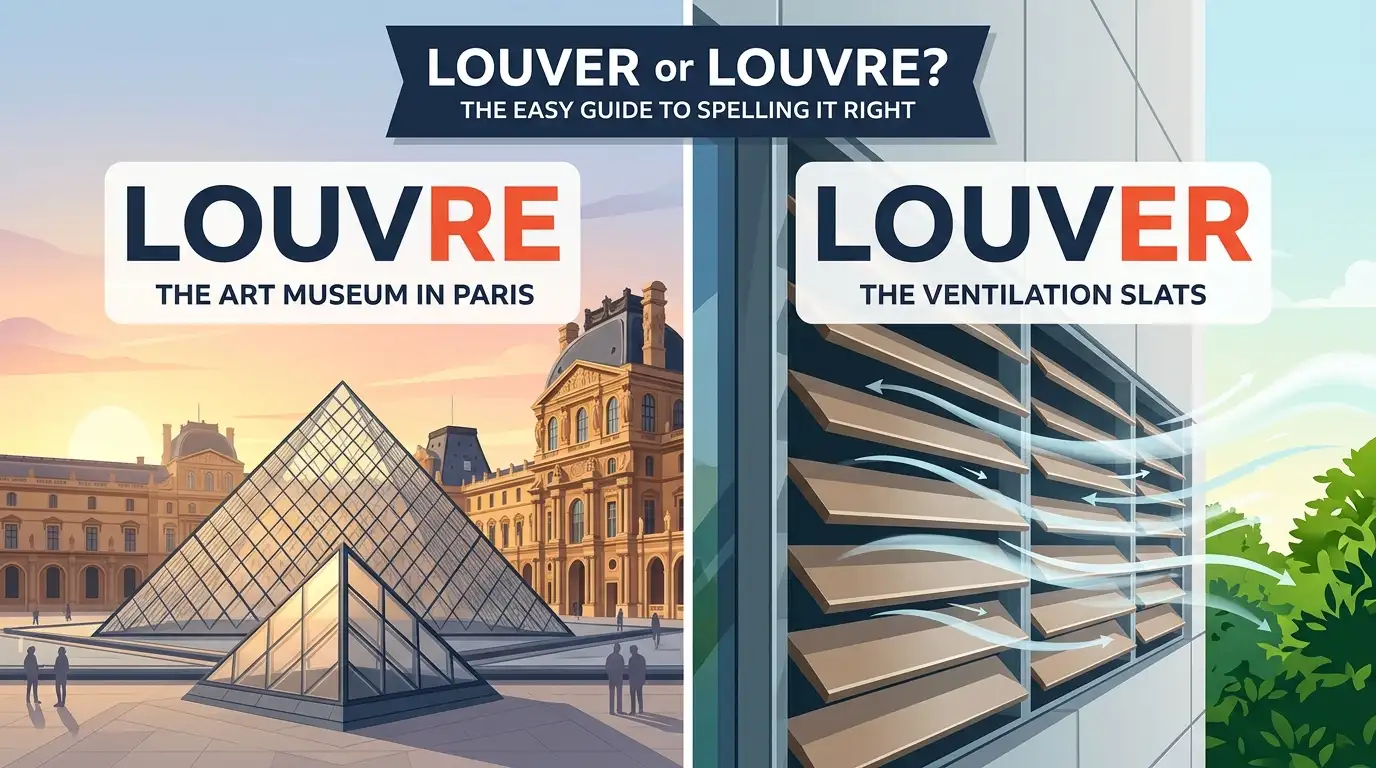
Louvre is the famous Paris museum. Louver is the American spelling for the slanted slats on blinds, vents, shutters, and doors. In British English, “louvre” can mean both.
Years ago, I wrote a caption for a travel piece. I typed “the Louver in Paris” and hit send. My editor wrote back with one line: “Nice photo. Wrong spelling.” I felt my face go hot.
I had spelled a world famous museum wrong. And I teach English!
Here is why this trips people up. The two words sound the same. They look almost the same. One is a place and the other is a thing on your window. Add the US and UK spelling split, and the confusion is no surprise.
This guide fixes it for good. You will learn what each word means, where they come from, and which one to pick. You will also get a cheat sheet you can save. Let’s clear this up.
Louver or Louvre: Quick Answer
Both words are pronounced LOO-ver in English. The difference is in the spelling and the meaning.
- Louvre is the museum in Paris. It is also the standard British spelling for slatted openings.
- Louver is the American spelling for slatted openings.
Two quick examples:
- “We spent four hours at the Louvre and still missed half of it.”
- “The louver on the attic window keeps rain out and lets air in.”
Never write “Louver” for the museum. It is a proper name, so it keeps its French spelling everywhere.
Where These Words Come From
The museum story is the fun one. The Louvre began as a fortress around the year 1190. King Philip II built it to guard Paris. Nobody agrees on the name’s origin. Some say it comes from an old word for a fortified tower. Others say it comes from a word linked to wolf hunting grounds. Today it holds the Mona Lisa, and glass pyramid doors let visitors in.
The slatted kind has a different path. In old French, a lover was a small roof tower. It had openings so smoke could escape. Over time, the word came to mean the angled slats themselves.
So the two words likely share a French root. Over the centuries, the spellings drifted apart. English then split the slatted meaning into two spellings, one for each side of the Atlantic.
Louver and Louvre Explained: Key Differences
Here is how each form works in real life.
| Term | Meaning | When to Use | Region/Context |
| Louvre (capitalized) | The art museum in Paris | Travel, art, history | Worldwide |
| Louver | Angled slats for air and light | Home design, building, cars | United States |
| Louvre (lowercase) | Angled slats for air and light | Home design, building | UK, Australia, much of the Commonwealth |
| Louvered | Having slats (an adjective) | “Louvered doors” | US spelling |
| Louvred | Having slats (an adjective) | “Louvred windows” | UK spelling |
Notice the pattern. A capital L and a place name means the museum. A lowercase word and a building part means slats.
Which Spelling Should You Use?
Pick based on who will read your work.
- For US readers: use louver for slats. Use Louvre for the museum.
- For UK or Australian readers: use louvre for both meanings. Capitalize it for the museum.
- For a global audience: write Louvre for the museum. For slats, match your main audience.
- For a product page or home improvement site: match your buyers. US shoppers search “louver.” UK shoppers search “louvre.”
One rule holds everywhere. The museum is always “Louvre.” No exceptions.
Common Mistakes with Louver and Louvre
Here are the errors I see most often. Each one has a simple fix.
| Mistake | Correction | Why It Happens |
| “I visited the Louver in Paris.” | “I visited the Louvre in Paris.” | The word sounds like the US slat spelling. |
| “Install a louvre vent” (in a US blog) | “Install a louver vent” | UK spelling slips into US writing. |
| “The Louvre door needs paint.” | “The louvered door needs paint.” | Writers capitalize it by habit. |
| “Louvered and louvred” mixed in one article | Pick one style and stay with it | Spell check allows both. |
| “The Lourve is huge.” | “The Louvre is huge.” | The letters get swapped when typing fast. |
That last one is sneaky. The letters u and v switch places, and the brain reads it as correct. Always check the middle of the word.
Louver and Louvre in Real World Examples
Seeing the words in action helps them stick.
A professional email: “Please review the attached quote for the aluminum louver system on the east wall.”
A news headline: “Record Crowds Fill the Louvre as Paris Welcomes Autumn Visitors”
A social media post: “Spent the morning at the Louvre and the Mona Lisa is smaller than I expected!”
A formal report: “The building’s ventilation design includes louvred panels to reduce heat gain.” (UK style)
A US building spec: “Install louvered shutters on all south facing windows.” (US style)
Data, Trends, and Usage
People mostly search this term for informational reasons. They want a quick answer on spelling, not a long lecture.
Interest spikes in a few places. Travel bloggers and students search it before writing about Paris. Homeowners and contractors search it when shopping for vents and shutters. English learners search it because the two spellings look so alike.
Here is why it matters now. More people write online than ever before. A spelling slip on a travel blog or a product page makes you look careless. Search engines also reward pages that match what people actually type. Using the right spelling for your audience helps readers trust you and find you.
Your Cheat Sheet
Save this part.
Louver or Louvre: Quick Reference
- Talking about the Paris museum? Write Louvre.
- Writing for Americans about slats? Write louver.
- Writing for Brits about slats? Write louvre.
- Describing something with slats? Use louvered (US) or louvred (UK).
- Pronunciation for all of them: LOO-ver.
- Trick to remember: the museum is French, so it ends with the French re.
- Typing check: after Lou, the next letter is v, not r.
Standalone Comparison Table
| Term/Variant | Meaning | Region/Context | Best Used When |
| The Louvre | Paris art museum | Worldwide | Writing about travel, art, or history |
| Louver | Slatted opening | US | Writing for American readers |
| Louvre | Slatted opening | UK, Australia, Commonwealth | Writing for British readers |
| Louvered | Fitted with slats | US | Describing doors, shutters, vents |
| Louvred | Fitted with slats | UK | Describing doors, shutters, vents |
FAQ
Q: What does louver mean? A: A louver is a set of angled slats in a door, window, or vent. The slats let air and light in while blocking rain or direct sun.
Q: How do you use louvre correctly? A: Capitalize it for the museum: “the Louvre.” Use lowercase for slats if you write in British English: “a louvre window.”
Q: Louver vs Louvre: what is the difference? A: They share a meaning for slats, but spelling depends on region. The museum is always spelled Louvre, no matter where you live.
Q: Is louvre acceptable in formal writing? A: Yes. It is the standard spelling in British formal writing. In American formal writing, use louver for slats and keep Louvre for the museum.
Q: Which version is correct, louver or louvre? A: Both are correct for slats. Choose by audience. For the museum, only Louvre is correct.
Q: Where does the word come from? A: Both likely come from old French. The museum name goes back to a fortress from around 1190. The slat meaning comes from a roof tower with openings.
Q: Can louvre be used for car parts? A: Yes. Louvres or louvers appear on car hoods, vents, and body panels. Use the spelling that matches your readers.
Conclusion
Let’s wrap it up with the main points.
First, Louvre is always the museum in Paris. Second, louver is the US spelling for slats. Third, louvre is the UK spelling for slats. Fourth, the pronunciation never changes.
My advice is simple. Decide who you are writing for before you type. Match your spelling to your readers. And whenever you mean the museum, write Louvre with confidence.
I still remember that red faced moment with my editor. Now I never miss it. You won’t either.
Now you know exactly how to handle louver and louvre. Bookmark this guide so you never second guess it again. Then share it with a friend who is planning a trip to Paris.
Read More: Tieing or Tying: The Real Answer in 1 Minute

My name is Ayesha Sadiqah, the writer behind this website. I write in-depth articles on English spelling, word comparisons, grammar, and vocabulary to help learners make better language choices. Every guide is designed to provide accurate, practical, and easy-to-understand information.











1 thought on “Louver or Louvre: The Easy Guide to Spelling It Right”