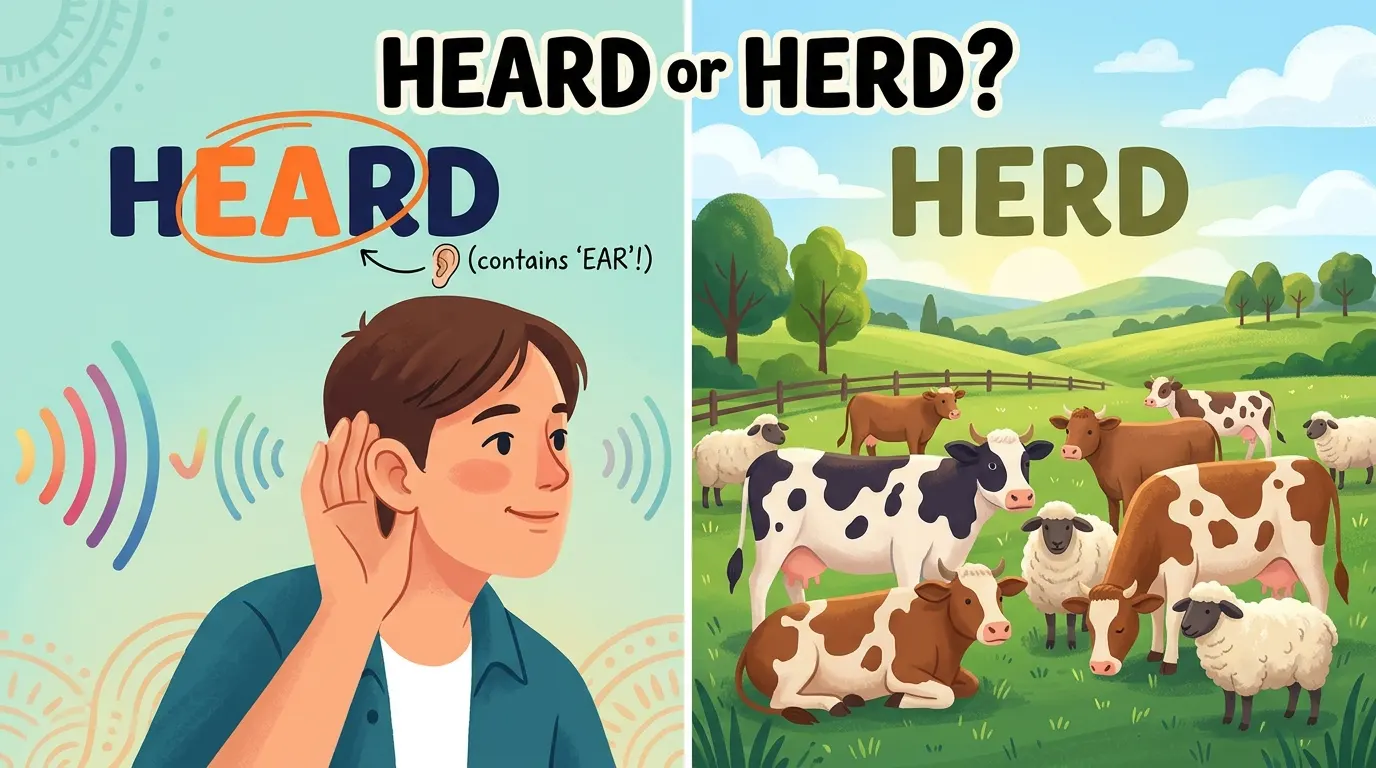
Heard is the past tense of “hear.” It means you picked up a sound or news. Herd is a group of animals, or the act of gathering them together. They sound the same, but they mean very different things.
A student once handed me a short story about a farm. It had one line I still remember: “The farmer herd a noise in the barn.”
I laughed. Then I stopped. The mistake was almost poetic. A barn is full of animals, and that is exactly where the word “herd” lives.
That is why this pair is so sneaky. Heard and herd sound identical. Your ear cannot help you. Only your eyes can tell them apart. And when you write fast, your brain grabs the wrong one without asking.
Maybe you are a student. Maybe you write blog posts or work emails. Either way, one wrong letter can make a smart sentence look sloppy.
This guide fixes that. You will learn what each word means, where each one came from, and how to pick the right one in a blink. You will also get a cheat sheet and a simple trick you will not forget. Ready? Let’s go.
Heard or Herd: Quick Answer
Both words are said the same way: HURD. They are called homophones. That means same sound, different meaning.
- Heard is a verb. It is the past tense of “hear.”
- Herd is a noun (a group of animals). It can also be a verb (to guide or gather).
Two quick examples:
- “I heard the doorbell, but nobody was there.”
- “A herd of elephants crossed the road.”
Here is a fast test. Ask yourself: “Did I use my ears?” If yes, write heard. If you mean animals or a crowd, write herd.
Where These Words Come From
Both words are old. Very old.
Heard grew out of an Old English word, hieran, which meant “to hear.” Over time, English trimmed it down into the short word we use today. The “ear” tucked inside “heard” is not an accident. It points straight to the sense you use.
Herd also comes from Old English. The word heord meant a group of animals kept together, like cattle or sheep. People who looked after them were called herdsmen. You can still see the word hiding in “shepherd,” which means “sheep herder.”
So why the mix up? Over centuries, English spelling changed, but sounds changed faster. Today two words with different roots land on the same sound. Your ear hears one word. Your eyes must pick the right one.
Heard and Herd Explained: Key Differences
Here is how each word works in real life.
| Term | Meaning | When to Use | Region/Context |
| Heard | Past tense of “hear” | Talking about sounds, news, or being listened to | All English |
| Herd (noun) | A group of animals | Cattle, deer, elephants, sheep | All English |
| Herd (verb) | To gather or drive together | Moving people or animals as a group | All English |
| Herd mentality | Following the crowd | Talking about group behavior | All English |
| Herd immunity | Group protection from disease | Health and science writing | All English |
Notice that neither word changes by region. US, UK, and Australian writers all use them the same way. That is good news. There is only one right answer.
Which Word Should You Use?
Pick based on what you mean.
- Talking about sound or news? Use heard. “I heard you got the job.”
- Talking about animals? Use herd. “The herd moved slowly.”
- Talking about a crowd that follows others? Use herd. “Investors often follow the herd.”
- Talking about gathering or guiding? Use herd as a verb. “She herded the kids into the car.”
- Talking about being listened to? Use heard. “I just want to feel heard.”
Here is a memory trick you can use forever. Heard has EAR in it. Hear is what ears do. And herd has no ear at all. It has “her” in front, and the word “herd” often makes you picture a big, quiet group of animals.
Common Mistakes with Heard and Herd
Here are the slips I see most often. Each one has a simple fix.
| Mistake | Correction | Why It Happens |
| “I herd a strange sound.” | “I heard a strange sound.” | The sound matches, so the wrong spelling slips in. |
| “A heard of buffalo ran past.” | “A herd of buffalo ran past.” | The writer thinks “heard” looks more normal. |
| “They have a heard mentality.” | “They have a herd mentality.” | The idea is about animals, not ears. |
| “Have you herd the news?” | “Have you heard the news?” | Fast typing and autopilot. |
| “She heard the sheep into the pen.” | “She herded the sheep into the pen.” | The verb “herd” gets confused with “hear.” |
Autocorrect will not save you here. Both words are real. Your spell check sees a correct word and moves on. You have to catch it yourself.
Heard and Herd in Real World Examples
Seeing the words in action helps them stick.
A professional email: “I heard from the client this morning. They want the report by Friday.”
A news headline: “Wildlife Team Spots Rare Herd of Deer Near Mountain Trail”
A social media post: “Just heard my favorite song in a coffee shop. Made my whole day!”
A formal report: “Analysts warned that the herd mentality in the market could push prices too high.”
A health article: “Vaccines help build herd immunity, which protects people who cannot be vaccinated.”
Data, Trends, and Usage
People search this pair for informational reasons. They want a quick answer, not a lesson.
Interest runs highest among students, English learners, bloggers, and office workers. These are the people who write every day and cannot afford silly slips. Interest also jumps when “herd immunity” shows up in the news, because readers want to know the right spelling.
Why does this matter now? We write more than ever, mostly on phones, mostly fast. Voice typing also makes things worse. A voice tool hears the sound and picks a spelling for you. It does not always pick the right one. A quick proofread is now a real skill.
Your Cheat Sheet
Save this part.
Heard or Herd: Quick Reference
- Used your ears? Write heard.
- Talking about animals? Write herd.
- Talking about a crowd that follows? Write herd mentality.
- Guiding a group? Write herd or herded.
- Memory trick: heard has EAR in it.
- Final check: read the sentence aloud, then ask, “Is this about sound or a group?”
- Voice typing users: always proofread homophones.
Standalone Comparison Table
| Term/Variant | Meaning | Region/Context | Best Used When |
| Heard | Past tense of “hear” | All English | You noticed a sound or news |
| Herd | A group of animals | All English | You describe cattle, deer, or elephants |
| Herded | Past tense of “to herd” | All English | You guided people or animals together |
| Herd mentality | Following the crowd | All English | You describe group behavior |
| Herd immunity | Group disease protection | Health and science | You write about vaccines or public health |
FAQ
Q: What does heard mean? A: Heard is the past tense and past participle of “hear.” It means you noticed a sound, or you received news. Example: “I heard it from a friend.”
Q: How do you use herd correctly? A: Use herd for a group of animals, such as “a herd of cows.” You can also use it as a verb, like “to herd the kids inside.”
Q: Heard vs herd: what is the difference? A: They sound the same but mean different things. Heard is about listening. Herd is about a group or gathering.
Q: Is herd acceptable in formal writing? A: Yes. Herd is a standard word. Phrases like “herd immunity” appear in science and news. “Herd mentality” is also common in business and psychology writing.
Q: Which one is correct, heard or herd? A: It depends on your meaning. If you mean a sound or news, heard is correct. If you mean animals or a group, herd is correct.
Q: Where does herd come from? A: Herd comes from Old English heord, meaning a group of animals kept together. You can also spot it in the word “shepherd.”
Q: Can herd be used for people? A: Yes. As a noun, it often describes a crowd that follows others. As a verb, it means to guide people together, such as “to herd guests into the hall.”
Conclusion
Let’s wrap this up with the key points.
First, heard is about your ears. Second, herd is about animals or a group. Third, the two words sound exactly the same, so only your eyes can catch the difference. Fourth, spell check will not always rescue you.
My advice is simple. Before you hit send, pause on any sentence with this sound. Ask yourself: sound, or group? That one second can save you a red face.
I still think about that farmer and his barn. My student laughed when I showed him the mix up. He never made it again.
Now you know exactly how to use heard and herd. Bookmark this guide so you never second guess them again. Then share it with a friend who types fast and checks slow.
Read More: Louver or Louvre: The Easy Guide to Spelling It Right

My name is Ayesha Sadiqah, the writer behind this website. I write in-depth articles on English spelling, word comparisons, grammar, and vocabulary to help learners make better language choices. Every guide is designed to provide accurate, practical, and easy-to-understand information.











3 thoughts on “Heard or Herd: Never Mix Them Up Again”